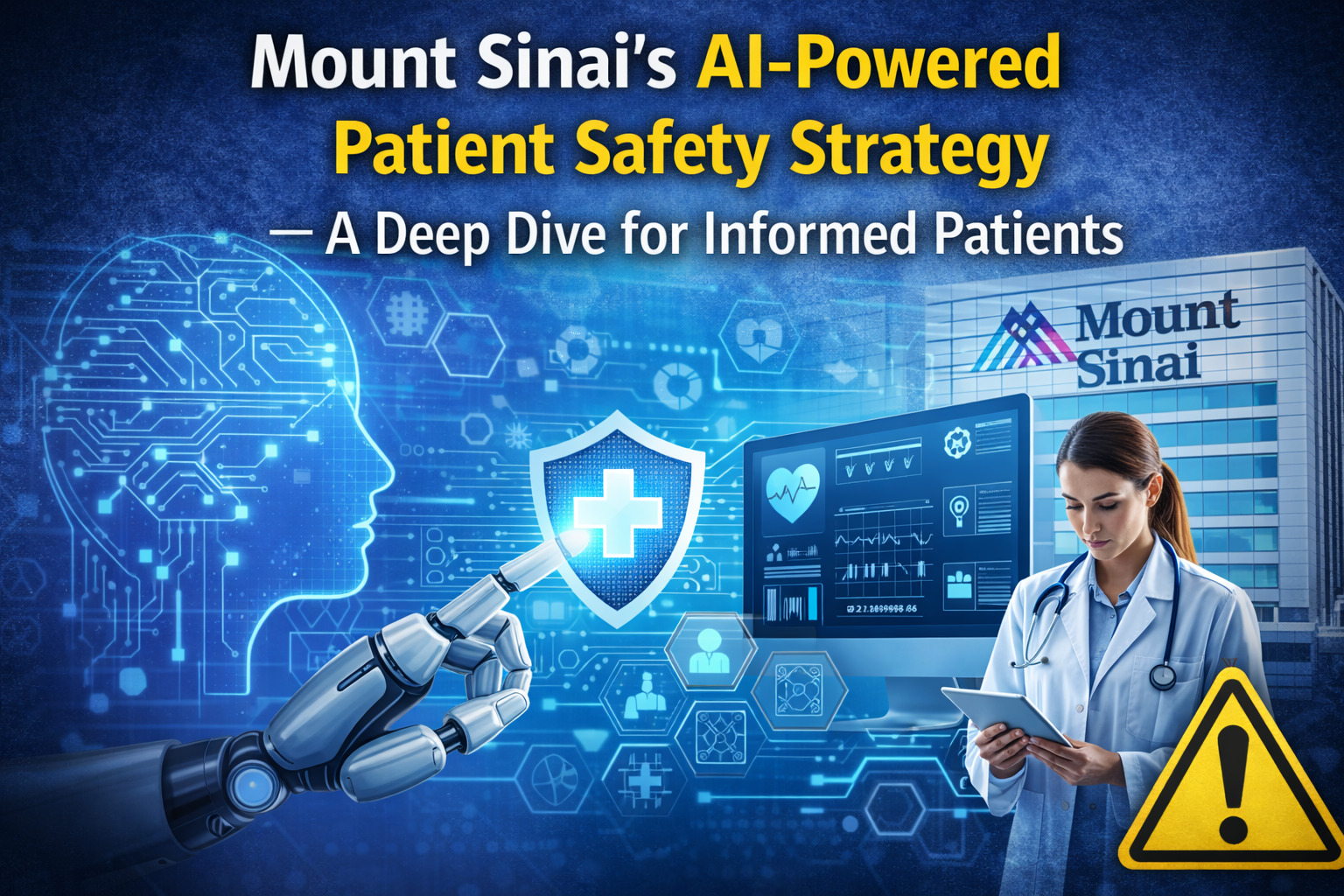
Mount Sinai’s AI-Powered Patient Safety Strategy – A Deep Dive for Informed Patients
Mount Sinai Hospital Announces New Health Update – What Patients Need to Know About Services and Safety
Introduction: The Hospital That’s Treating AI Like Infrastructure
Walk into most hospitals in 2026, and AI is, at best, a pilot program in one department. Walk into The Mount Sinai Hospital and you’re walking into a system where artificial intelligence has been deliberately woven into clinical workflows since at least 2017before ChatGPT was a household name, before ‘AI in healthcare’ became a conference theme, before it was fashionable.
That early start matters. A lot. Because the difference between a hospital that’s integrating AI thoughtfully and one that’s bolting it on reactively is the difference between a tool that reduces clinician burnout and one that creates new problems. This child page goes deeper than the pillar article on the specific AI systems in use at Mount Sinai, what the peer-reviewed evidence says, and critically, what informed patients should know, ask, and expect.
The Windreich Department: Why It Matters That Mount Sinai Did This First
In 2021, Mount Sinai established the Windreich Department of Artificial Intelligence and Human Health at the Icahn School of Medicine, the first dedicated AI department at any U.S. medical school. It’s chaired by Dr. Girish N. Nadkarni, MD, MPH, who serves simultaneously as Chief AI Officer of the Mount Sinai Health System.
This structural move signals something important: Mount Sinai isn’t treating AI as a vendor relationship or a technology experiment. It’s a permanent academic unit with researchers, clinicians, ethicists, and data scientists whose job is to develop, evaluate, deploy, and continuously improve patient-centered AI tools.
The department operates out of the Hamilton and Amabel James Center for Artificial Intelligence and Human Health, a dedicated facility on the Manhattan campus with large-scale supercomputers and cloud computing capability. Translation: this is genuine infrastructure, not a conference room with a few laptops.
“We were the first in the United States to establish a medical school department focused solely on the development of patient-centered AI tools, education, and resources.” – Icahn School of Medicine at Mount Sina. i
The Tools, One by One: What’s Running, What’s Planned, and What the Evidence Shows
Dragon Copilot: Ambient AI Documentation
Launched: November 2025, select departments. System-wide expansion: 2026.
What it does: Dragon Copilot listens to the natural conversation between a clinician and patient using ambient AI, then automatically generates clinical documentation within the EHR. The clinician reviews and approves, but doesn’t spend the visit typing or clicking.
What the evidence suggests: Documentation burden is a leading cause of physician burnout. Studies published in journals including JAMA and Health Affairs have repeatedly shown that administrative tasks consume upward of 30–50% of physician time. Any tool that meaningfully reduces that load without sacrificing documentation accuracy directly frees up time for patients.
What to watch for: Ambient listening raises legitimate privacy questions. Mount Sinai’s rollout includes ‘robust training, feedback, and evaluation’ at each phase. Patients are advised to ask their provider whether ambient AI is active and what consent process applies.
OpenEvidence: Real-Time Clinical Decision Support
Launched: April 2026 (collaboration announced). This is Mount Sinai’s first enterprise-wide AI deployment across all clinical roles.
What it does: OpenEvidence is embedded directly into Epic Mount Sinai’s electronic health record. Physicians, nurses, and pharmacists can type medical questions in natural language and receive answers sourced from peer-reviewed literature and clinical guidelines, without leaving their workflow.
Why this is significant: Clinical decisions should always be grounded in current evidence. But evidence evolves fast, fast guidelines update, new drug interactions are discovered, and diagnostic criteria shift. OpenEvidence gives every member of the care team,eam not just the attending physician,cian access to the same level of current evidence. That’s a meaningful equity play within care delivery itself.
PRISM (Oncology Clinical Trial Matching)
Launched: January 2026, Tisch Cancer Center.
What it does: PRISM, built on Triomics’ OncoLLM, automatically reviews a cancer patient’s EHR data and matches them to eligible clinical trials. The platform runs systemwide, meaning a patient in any of Mount Sinai’s seven hospitals can be identified as a candidate.
Why it matters: Clinical trial participation is one of the most underused pathways in cancer care. Eligible patients frequently miss trials because of information gaps between treating physicians and research teams. PRISM bridges that gap algorithmically, consistently, and at scale.
NutriScan (ICU Nutrition Risk Prediction)
Published in Nature Communications, December 2025. Winner of the 2024 Hearst Health Prize.
What it does: NutriScan uses machine learning to predict which ICU patients on ventilators are at risk of underfeeding during their critical first week. This enables clinicians to adjust nutrition protocols proactively rather than reactively.
The underlying evidence: Malnutrition in hospitalized patients is both common and consequential, initially linked to longer stays, slower recovery, and higher mortality. Early intervention, guided by an accurate rimodella, has measurable clinical impact.
AEquity (AI Fairness Tool)
Published: September 2025. Developed at the Windreich Department.
What it does: AEquity is a tool designed to identify bias and fairness issues in health AI algorithms. Dr. Nadkarni described its purpose starkly: “If we want these technologies to truly serve all patients, we need to pair technical advances with broader changes in how data is collected, interpreted, and applied in health care.” AEquity is valuable for developers, regulators, and auditors, essentially a quality-control layer for AI itself.
The Ethics Layer: What Mount Sinai Is Getting Right (and Where Questions Remain)
Let me be honest here: a hospital system publishing press releases about its own AI achievements is not unbiased evidence. The fact that Mount Sinai has the infrastructure, the rankings, and the stated commitments doesn’t automatically mean every patient benefits equally or that every deployment goes smoothly.
But there are things Mount Sinai is doing that genuinely differentiate it from systems that are adopting AI reactively:
- The Windreich Department includes bioethicists alongside data scientists. This is not standard practice.
- AEquity is an active internal mechanism for identifying when AI tools produce unfair outcomes. Most health systems don’t have this.
- The 2025 equity goal in patient safety explicitly calls for data-driven monitoring of disparate outcomes by patient population, a commitment to surfacing what you might otherwise miss.
- Every major deployment announcement explicitly states the ‘human-led, human-centered’ principle: AI tools assist clinicians; clinicians make decisions.
Where questions remain: The clinical trial matching platform, the ambient documentation tool, and predictive safety tools are all relatively new. Long-term outcome data: Does PRISM actually increase trial enrollment equitably across race, income, and geography? It isn’t fully published yet. The research pipeline is real and robust; the outcomes data is still accumulating.
Practical Takeaways for Patients Visiting Mount Sinai in 2026
- Ask whether your visit includes ambient AI documentation (Dragon Copilot) and confirm you’re comfortable with that.
- If you have cancer or a serious chronic condition, explicitly ask your physician: ‘Am I eligible for any clinical trials?’
- Enroll in MyChart before your first appointment to access your health records, test results, and care team messaging.
- If you’re discharged from an inpatient stay, ask what readmission risk category you fall into and what support is in place.
- For questions about AI use in your care, you can reach Mount Sinai’s patient relations team through mountsinai.org/patients