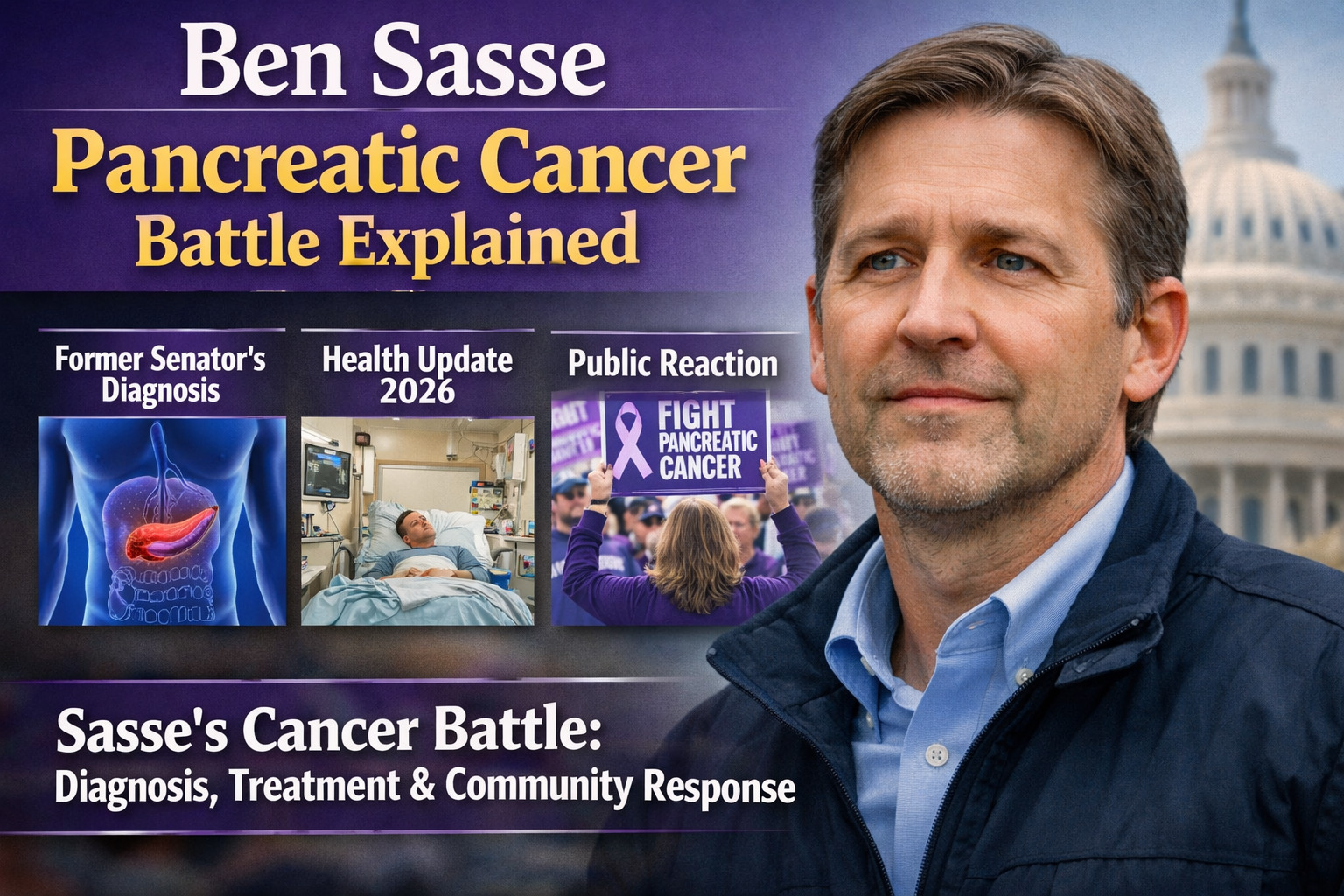
Ben Sasse Pancreatic Cancer Battle Explained: Former Senator’s Diagnosis, Health Update, and Public Reaction in 2026
By a Health & Politics Correspondent | Last Updated: April 10, 2026
Ben Sasse is a former U.S. Republican Senator from Nebraska (2015–2023) who was diagnosed with metastatic stage-four pancreatic cancer on December 14, 2025, at age 53. His cancer had already spread to five organ systems by the time it was detected, including his liver, lungs, lymph nodes, vascular system, and the originating site in the pancreas. He is currently enrolled in a clinical trial at MD Anderson Cancer Center in Houston, Texas, involving an experimental drug called daraxonrasib. Despite being given a 3-to-4-month life expectancy at diagnosis, Sasse has surpassed 100 days and reports a 76% reduction in tumor volume as of April 2026.
Introduction: The Diagnosis Nobody Saw Coming
Around Halloween 2025, Ben Sasse started having persistent back pain. He figured he’d pulled something while training for a triathlon. That’s a reasonable assumption. He’s fit, disciplined, the kind of man who writes books about the meaning of work and then lives accordingly.
He was wrong.
On December 14, 2025, full-body scans revealed something far worse. When he asked his doctors to be blunt, they were: “Ben Sasse’s torso is chock-full of tumors.” Two weeks before Christmas, the 53-year-old former Nebraska senator learned he had metastasized stage-four pancreatic cancer and that it had already spread to five different organ systems.
On December 23, 2025, he told the world about it in a post on X. No PR spin. No carefully managed press release. Just raw, honest, almost startling clarity: “Last week I was diagnosed with metastasized, stage-four pancreatic cancer, and am gonna die.” The internet stopped scrolling.
This is a complete guide to what happened, what’s happening now, and what Ben Sasse’s battle reveals about one of America’s most feared diseases.
Who Is Ben Sasse? A Brief Background
To understand why this hit people so hard, you have to understand who Ben Sasse is and who he isn’t.
He isn’t a typical politician. He came from academia; he was the president of Midland University in Fremont, Nebraska, before getting elected to the U.S. Senate in 2014. He has a PhD from Yale. He wrote bestselling books about raising resilient kids and American civic identity. He has a habit of quoting Tocqueville in political settings, which either impresses or annoys people, depending on your tolerance for intellectual senators.
He served Nebraska in the Senate from 2015 to early 2023, when he resigned to become the 13th president of the University of Florida, the first non-alumnus in that role in decades. He lasted 17 months there before resigning again, this time to care for his wife Melissa, who had been diagnosed with epilepsy. His daughters are 22 and 24; his son just turned 14.
In the Senate, Sasse was known as a principled conservative who wasn’t afraid to cross his own party. He was one of seven Republicans who voted to convict Donald Trump in the second impeachment trial following January 6, 2021, a vote that cost him politically but which he has never apologized for. He’s the kind of politician people cross the aisle to defend when the news is bad, which tells you something.
The Diagnosis: What Stage-Four Pancreatic Cancer Actually Means
Let’s talk medicine for a moment, because the words “stage-four pancreatic cancer” carry weight that needs unpacking.
Pancreatic cancer is notoriously silent. It often causes no specific symptoms in early stages, and there’s currently no widely recommended screening test for the general population. By the time most patients feel abdominal pain radiating to the back, unexplained weight loss, and loss of appetite, the cancer has already spread. That’s exactly what happened to Sasse.
Stage IV means metastatic: cancer cells have traveled from the pancreas to distant organs. In Sasse’s case, that meant five forms of cancer simultaneously: pancreatic (the origin), liver, lung, lymphoma, and vascular. His doctors were unambiguous: surgery was pointless. There were simply too many tumors.
According to the American Cancer Society, approximately 67,440 Americans will be diagnosed with pancreatic cancer in 2025, and around 51,980 are expected to die from it. The 5-year survival rate for stage IV pancreatic cancer sits at just 3–5%, according to data cited by the National Comprehensive Cancer Network (NCCN) and the American Society of Clinical Oncology (ASCO).
Although pancreatic cancer accounts for roughly 3% of all new U.S. cancer cases, it’s the third leading cause of cancer death and is projected to become the second leading cause of cancer death by 2030. Those numbers explain why Sasse called it, without hesitation, a death sentence.
The Announcement: A Viral Post That Moved America
Sasse’s December 23, 2025, post on X wasn’t clinical or carefully worded. It was startlingly human. He wrote about death as “a wicked thief” that pursues everyone. He talked about being “wired to work and build” and how hard it is to accept a disease that takes that away. He praised Melissa, his wife of 31 years. He talked about his kids. He said he wasn’t going down without a fight.
And then he mentioned immunotherapy with genuine excitement. “One sub-part of God’s grace is found in the jaw-dropping advances science has made in the past few years in immunotherapy and more,” he wrote.
The response was bipartisan and immediate. His former Senate colleague Pete Ricketts called it heartbreaking. Democratic Congressman Jared Moskowitz, whose father died of the same cancer, wrote perhaps the most visceral response: “I’m sorry, Ben. My dad had the same diagnosis. It was a death sentence. It humbles you quickly. We got 18 months together, and then silence. You wouldn’t wish this on your worst enemy. We have not made enough progress on pancreatic cancer detection nor treatment.”
Within hours, Sasse’s post had millions of impressions. Political adversaries set aside grievances. Something about the raw honesty, the refusal to dress up a terminal diagnosis, cut through the noise of a deeply polarized moment in American public life.
Treatment: Inside the Clinical Trial at MD Anderson
Two weeks after his diagnosis, Sasse was accepted into a clinical trial at MD Anderson Cancer Center in Houston, Texas, widely regarded as one of the top cancer hospitals in the world. The trial involves a drug called daraxonrasib, developed by Silicon Valley biotech company Revolution Medicines.
Daraxonrasib is a targeted therapy, not traditional chemotherapy. It’s taken orally. But make no mistake, the side effects are brutal. Sasse has described the sensation as “nuclear.” The drug prevents his skin from healing properly, causing constant bleeding, particularly on his face. He’s appeared in interviews with visible dried blood on his face, something he’s addressed with characteristic dark humor rather than embarrassment.
In February 2026, Sasse revealed he was taking 55 milligrams of morphine per day to manage the pain from tumors pressing against his spine. He was sleeping 15 to 16 hours a day. He’d lost 24 pounds since his diagnosis.
And yet. By April 2026, Day 99 past his original 3-to-4-month prognosis, his tumor volume was down 76% from late December. His pain, he says, has been reduced by 80%.
“In mid-December I got a three-to-four month life expectancy, and I’m at Day 99 or something since then, and I’m doing a heck of a lot better than I was doing at Christmas.” – Ben Sasse, NYT Interesting Times podcast, April 2026
He’s now been told there’s a 30% chance he could live the better part of a year, which, as he put it to NPR’s Steve Inskeep, “sounds a lot better than three or four months.”
His oncologists at MD Anderson, Drs. Shubham Pant and Bob Wolff have described their work with a metaphor Sasse clearly loves repeating: they’re chipping at a giant Hoover Dam with a pickax, making tiny cracks, hoping someday those cracks will converge. “Maybe 10 years,” one of them told him. He’s under no illusion that he’ll be alive to see it.
He’s based in Austin, Texas, two hours and 40 minutes from Houston, which allows him to commute for treatment rather than live in a hospital. He spends a maximum of two days per week at MD Anderson.
Life After Diagnosis: The ‘Not Dead Yet’ Philosophy
Here’s the thing about Ben Sasse that nobody predicted: he’s doing a lot of talking.
He launched a podcast titled, with unmistakable Monty Python energy, Not Dead Yet, co-hosted with journalist Chris Stirewalt. The guest list reads like a bucket list: Conan O’Brien, Mike Rowe, and Al Michaels. As Sasse told KLIN Radio with amused cynicism, “Turns out, if you’re dying and you call guys up and ask them to come on your podcast, they’ll say ‘Okay.'”
He’s writing columns for The Wall Street Journal. He’s doing interviews with the Hoover Institution, with NPR, with The New York Times. In April 2026, he sat down with NYT columnist Ross Douthat for a wide-ranging conversation that touched on faith, mortality, American politics, and the strange clarity that comes from a terminal diagnosis. His face was visibly covered in dried blood from his treatment. He didn’t blink.
His focus, he says, has narrowed to what actually matters: his wife, his children, his God. The boredom of political combat, the performative outrage of modern partisanship, it all looks different when you’re counting days. He told Douthat he felt a “heaviness” about not being there for his 14-year-old son when he turns 16. About not walking his daughters down the aisle.
But he’s also found something he didn’t expect: peace.
“I’ve continued to feel a peace about the fact that death is something that we should hate… Death is the final enemy. But it’s pretty great, too, that it’s final.” – Ben Sasse, KLIN Radio interview, February 2026
When he dies, he’s told interviewers, he’ll be buried in Arlington, Nebraska, overlooking the Elkhorn River.
What Ben Sasse’s Case Reveals About Pancreatic Cancer Research
Beyond the human story, Sasse’s public battle has thrown a spotlight on one of oncology’s most stubborn problems.
Pancreatic cancer is so lethal primarily because it’s found so late. The pancreas sits deep in the abdomen, behind the stomach. The symptoms it produces, back pain, fatigue, and mild digestive changes, are easy to attribute to dozens of other causes. There’s no equivalent of a mammogram or colonoscopy for the pancreas. And the tumor biology is particularly hostile: it creates physical and chemical barriers that reduce the effectiveness of traditional treatments.
UCLA researchers recently reported progress on an experimental cell-based immunotherapy using natural killer T (NKT) cells genetically modified to specifically recognize and attack pancreatic cancer cells. In mouse studies, the therapy slowed tumor growth and extended survival, even after the cancer had spread. Human studies are still needed.
Daraxonrasib, the drug Sasse is taking, represents a different approach: targeted inhibition of specific molecular pathways that pancreatic cancer cells rely on. The fact that it’s shrinking Sasse’s tumors dramatically, in a matter of weeks, is genuinely notable, even if it won’t cure him. Clinical trials like his generate the data that eventually, years later, give someone else a fighting chance.
As Rep. Moskowitz noted in his response to Sasse’s announcement, not enough progress has been made on pancreatic cancer detection or treatment. Sasse would agree. He’s said publicly that he hopes his participation in the trial will be useful to future patients, and that his dying might have some utility beyond the personal.
Public Reaction and Political Legacy
The outpouring in response to Sasse’s diagnosis was notable not just for its volume but for who participated. In a political era defined by tribal contempt, figures across the spectrum responded with genuine warmth.
Former colleague Deb Fischer called it “very sad” news, noting his Christian faith would anchor him. Senator Pete Ricketts, who succeeded Sasse in the Nebraska seat, called Sasse’s friendship “a blessing.” Alan Levine, chair-elect of Florida’s Board of Governors, wrote: “If there is a better man than my friend Ben Sasse, I don’t know who he is.”
Perhaps more revealing was the response from strangers. Sasse has repeatedly mentioned being overwhelmed by kindness from people who never met him, notes from cancer patients, from parents, from people who disagreed with every vote he ever cast but recognized a human being facing the hardest thing.
His political legacy is complicated, as all legacies are. He’s remembered as a principled conservative who found ways to antagonize both parties, voted against Trump’s impeachment acquittal, but also presided over a controversial and expensive 17-month tenure at the University of Florida that raised questions about spending. History will sort through all of it. What’s clear right now, in April 2026, is that Ben Sasse is using whatever time he has left with remarkable intentionality.
Frequently Asked Questions
Does Ben Sasse have a terminal diagnosis?
Yes. Sasse was diagnosed with metastatic stage-four pancreatic cancer in December 2025 and has publicly acknowledged it as a terminal diagnosis. He was initially given a 3-to-4-month life expectancy, though treatment has extended that prognosis significantly.
What treatment is Ben Sasse receiving?
He is enrolled in a clinical trial at MD Anderson Cancer Center in Houston, Texas, involving a targeted drug called daraxonrasib, developed by Revolution Medicines. He takes it orally and visits MD Anderson up to two days per week. The drug has reduced his tumor volume by 76% as of April 2026.
What is daraxonrasib?
Daraxonrasib is an experimental targeted therapy developed by Revolution Medicines, a Silicon Valley biotech company. It inhibits specific molecular pathways that cancer cells depend on for growth. It is not traditional chemotherapy, though it carries significant side effects, including skin damage and bleeding.
Is Ben Sasse still alive in 2026?
Yes. As of April 10, 2026, Ben Sasse is alive and has surpassed his original 3-to-4-month prognosis. He appeared on The New York Times’ Interesting Times podcast on April 9, 2026, noting he is now 99 days past his diagnosis date and doing considerably better than he was at Christmas 2025.
Why is pancreatic cancer so deadly?
Pancreatic cancer is deadly primarily because it is rarely detected in early stages. The pancreas sits deep in the abdomen, and early-stage cancer produces few noticeable symptoms. There is currently no standard screening test for the general population. By the time most patients are diagnosed, the cancer has already spread, making surgical removal impossible.
What is Ben Sasse doing with his remaining time?
Sasse has launched a podcast called Not Dead Yet, is writing columns for The Wall Street Journal, giving wide-ranging media interviews, and focusing on time with his wife Melissa and their three children. He’s based in Austin, Texas, traveling to Houston for treatment.
Sources and Further Reading
For verified, authoritative information on the topics covered in this article:
- Nebraska Examiner: Ben Sasse Announces Stage-Four Cancer Diagnosis
- The Hill: Ben Sasse Opens Up About Journey With Stage 4 Pancreatic Cancer
- NPR: Former Sen. Ben Sasse on Laughing His Way Through Terminal Cancer
- CNN Politics: Former Republican Sen. Ben Sasse Announces Stage 4 Pancreatic Cancer
- OncoDaily: Ben Sasse and Stage IV Pancreatic Cancer
- American Cancer Society: Pancreatic Cancer Statistics
- MD Anderson Cancer Center: Pancreatic Cancer Treatment
- National Cancer Institute: Pancreatic Cancer Overview
See also our child page – “Stage 4 Pancreatic Cancer Survival Rate, Treatment Options, and the Science Behind Daraxonrasib” – for a deep dive into the medical side of Ben Sasse’s diagnosis.