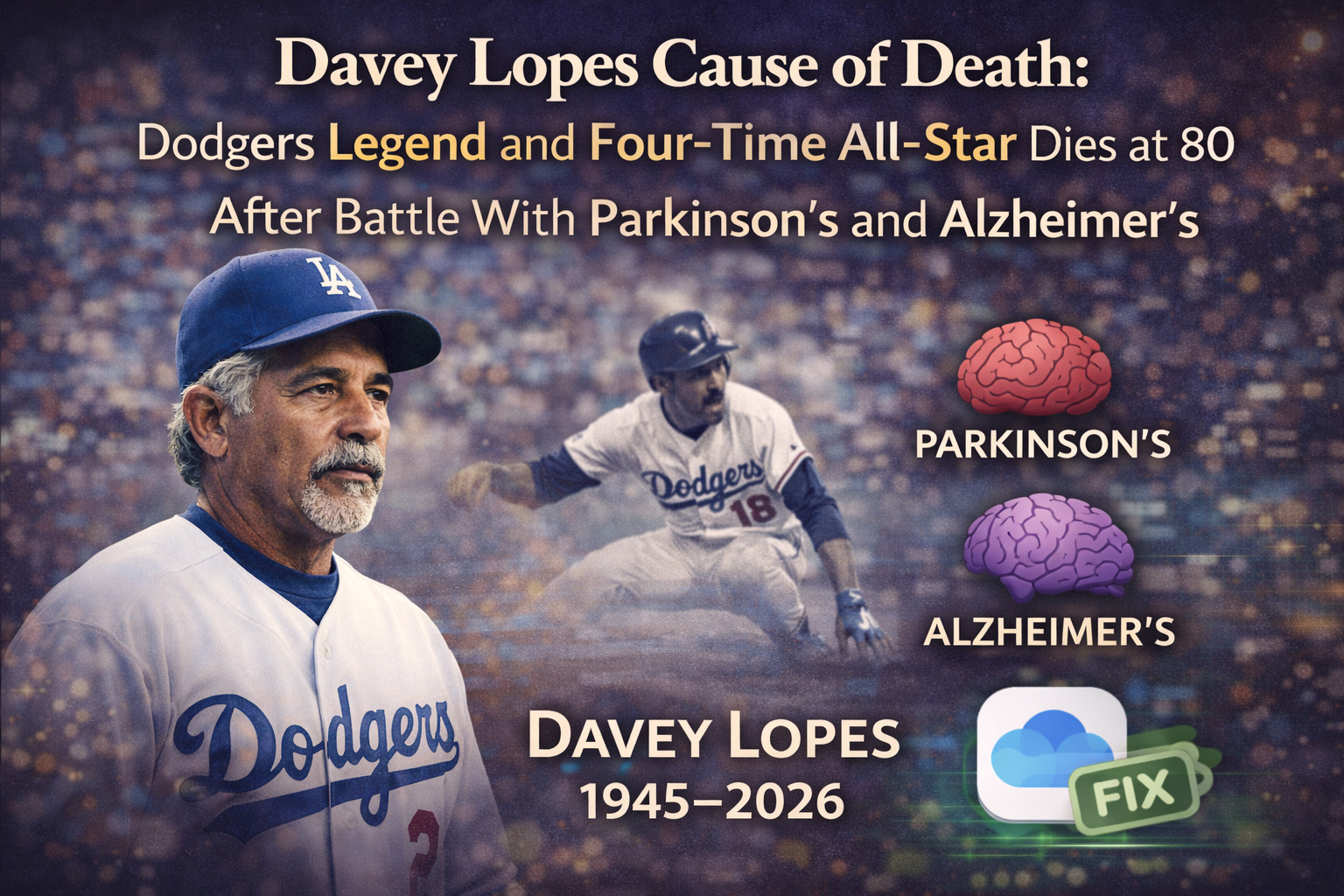
Davey Lopes Cause of Death: Dodgers Legend and Four-Time All-Star Dies at 80 After Battle With Parkinson’s and Alzheimer’s
By Sports Historian and Baseball Analyst | Updated: April 2026
The baseball world lost one of its fiercest competitors on April 7, 2026. Davey Lopes, the ferociously quick second baseman, four-time All-Star, and the engine of the most celebrated infield in Los Angeles Dodgers history, died at age 80 after a prolonged battle with both Parkinson’s disease and Alzheimer’s disease. His death was confirmed by the Los Angeles Dodgers organization and his family.
He wasn’t just a ballplayer. Davey Lopes was a thief, a warrior, and a tactician. The man stole 321 bases in his career, once swiped 38 consecutive bases without getting caught, a record that stood for decades, and played with the kind of furious intelligence that coaches still talk about in hushed, reverent tones. When the news broke, tributes poured in from former teammates, managers, and fans who remember watching him turn routine grounders into outs on the other team’s scorecard. The void he leaves isn’t just statistical. It’s emotional.
This article tells the complete story: who Davey Lopes was, how his health declined in his final years, what we know about the neurological diseases that claimed him, and why his legacy inside and outside the game runs deeper than any box score could capture.
What Was Davey Lopes’ Cause of Death?
Davey Lopes died from complications related to Parkinson’s disease and Alzheimer’s disease. Both are progressive neurodegenerative conditions, meaning they cause irreversible deterioration of brain cells over time. When a person is diagnosed with both simultaneously, a condition sometimes called “dual dementia” or comorbid neurodegenerative disease, the progression is typically faster and more severe than either disease alone. He was 80 years old at the time of his death.
Parkinson’s disease affects the neurons that produce dopamine, a neurotransmitter responsible for smooth, coordinated movement. According to the Parkinson’s Foundation, approximately 1 million Americans are currently living with the condition, with around 90,000 new diagnoses each year. It causes tremors, rigidity, slowness of movement, and balance problems and in its later stages, cognitive decline.
Alzheimer’s disease, the most common form of dementia, systematically destroys memory, thinking skills, and eventually the ability to carry out basic functions. The Alzheimer’s Association reports that more than 6.9 million Americans aged 65 and older are currently living with Alzheimer’s, with the number projected to reach nearly 13 million by 2050.
When both diseases occur together, they compound. Parkinson’s patients who develop Alzheimer’s (or vice versa) tend to experience accelerated cognitive and motor decline, heightened confusion, and increased vulnerability to secondary complications such as falls, infections, and pneumonia. It’s not yet fully understood why some individuals develop both, but research from institutions like the Mayo Clinic and the National Institute on Aging suggests shared protein pathways, specifically the misfolding of alpha-synuclein in Parkinson’s and tau/amyloid proteins in Alzheimer’s, may intersect in ways that accelerate neurological damage.
Lopes’ family had largely shielded him from the public eye during his illness, a common and dignified choice for many athletes navigating diseases that strip away the very qualities of precision, agility, and sharp thinking that defined their greatness.
Who Was Davey Lopes? A Legacy Built on Speed, Smarts, and Grit
Born David Earl Lopes on May 3, 1945, in East Providence, Rhode Island, Davey Lopes didn’t arrive in the majors until he was 27 years old ancient by modern developmental standards. He debuted with the Los Angeles Dodgers in 1972 and promptly made everyone forget about the late start.
What followed was one of the most decorated second-base careers of the 1970s and early ’80s.
Career highlights at a glance:
- 16 seasons in the major leagues (1972–1987)
- Teams: Los Angeles Dodgers, Oakland Athletics, Chicago Cubs, Houston Astros
- Four-time National League All-Star (1978, 1979, 1981, 1983)
- Career batting average: .263 with 155 home runs and 614 RBI
- 557 career stolen bases, top 20 all-time at the time of his retirement
- Two-time World Series champion (1981 with the Dodgers)
- Member of the legendary Dodgers infield alongside Ron Cey, Bill Russell, and Steve Garvey the longest-running infield unit in MLB history, staying intact for eight consecutive seasons
That infield. If you grew up watching baseball in Southern California in the 1970s, those four names are tattooed somewhere in your memory. Garvey at first, Lopes at second, Russell at short, Cey at third. They were together from 1973 to 1981, eight full seasons, which the Baseball Hall of Fame has recognized as the longest continuous run of the same starting infield in major league history. See the Baseball Reference page for the full unit stats.
But it was Lopes’ baserunning that bordered on supernatural. His record of 38 consecutive successful stolen base attempts set across the 1975–1976 seasons stood as the major league record until Vince Coleman broke it in 1988. The Dodgers ran the bases differently when Lopes was on first. Pitchers were rattled. Catchers held their breath. Opponents would walk him just to avoid the chaos that followed.
“Davey didn’t just steal bases,” said former Dodgers manager Tommy Lasorda in a 2003 interview. “He stole momentum. He stole the game right out from under you if you weren’t paying attention.”
The Stolen Base Record Nobody Talks About Enough
Here’s the kicker: Lopes’ 38-consecutive stolen base streak doesn’t appear in most casual sports discussions. It lives in the margins of baseball history, overshadowed by his more famous teammates and the team’s World Series runs. But for students of the game, it’s a remarkable demonstration of elite athleticism combined with extraordinary situational intelligence.
The modern analytics community has increasingly valued stolen bases differently than the old school did. Using expected value and success-rate thresholds, research from FanGraphs shows that a stolen base attempt only adds value to a team if the success rate exceeds roughly 70–73%. Lopes ran at an 83% career success rate, significantly above the historical average of approximately 67% for his era. In other words, he wasn’t just fast. He was right almost every time he chose to run.
That decision-making quality, knowing when to go, is what separates Lopes from the merely fast. It’s also, perhaps not coincidentally, the same kind of sharp processing that Alzheimer’s and Parkinson’s eventually corrode.
Understanding Parkinson’s Disease: What It Does and Why It’s Devastating
Parkinson’s disease is classified as a movement disorder, but that description undersells its complexity. It begins when dopamine-producing neurons in a region of the brain called the substantia nigra start to break down and die. Dopamine is essential for coordinating smooth, controlled movement, and without it, signals between the brain and muscles go haywire.
The four cardinal symptoms of Parkinson’s are tremor (usually at rest), muscle rigidity, bradykinesia (slowness of movement), and postural instability. But the disease also brings non-motor symptoms that are often underreported: depression, anxiety, cognitive impairment, sleep disorders, and autonomic dysfunction.
According to a 2023 study published in npj Parkinson’s Disease, the global prevalence of Parkinson’s has doubled over the last 25 years. The researchers attribute this in part to aging populations, environmental factors (including pesticide exposure), and declining physical activity. The study notes that men are approximately 1.4 times more likely to develop Parkinson’s than women, though the reasons remain under investigation.
For athletes, especially those who competed in contact sports or were exposed to repeated head impacts, the question of whether repetitive trauma accelerates neurodegeneration has become a defining issue. While Lopes played baseball rather than football or hockey, he was a rough, physical player who dove headfirst into bases regularly. Whether that played any role in his neurological decline is unknown, and it would be irresponsible to speculate without clinical evidence.
There is no cure for Parkinson’s. Treatments focus on managing symptoms through medication (primarily levodopa), physical therapy, and, in some cases, deep-brain stimulation (DBS) surgery. The Michael J. Fox Foundation for Parkinson’s Research has invested more than $2 billion in Parkinson’s research since 2000, making it one of the most-funded private research efforts in neuroscience. Learn more at the Michael J. Fox Foundation website.
Understanding Alzheimer’s Disease: Memory, Identity, and Loss
If Parkinson’s steals your movement, Alzheimer’s steals your self. That’s the brutal reality of this disease it doesn’t just take memories. It takes the personality, the stories, the relationships, the accumulated identity of a human life.
Alzheimer’s is the most common cause of dementia worldwide, accounting for 60–80% of all dementia cases according to the Alzheimer’s Association. It progresses in stages early, middle, and late with symptoms worsening over years or even decades. In the early stage, people may struggle with short-term memory and word-finding. In the middle stage, they may become confused about where they are, forget significant life events, and require assistance with daily tasks. In the late stage, they often lose the ability to communicate verbally, recognize loved ones, or move without assistance.
A landmark 2024 meta-analysis published in The Lancet Neurology identified 14 modifiable risk factors for Alzheimer’s, including hearing loss, depression, physical inactivity, smoking, obesity, high blood pressure, and social isolation. The researchers estimated that addressing all 14 factors could theoretically prevent or delay nearly half of all dementia cases globally.
The research also increasingly points toward a critical window of intervention: the brain changes associated with Alzheimer’s, specifically the buildup of amyloid plaques, begin 15 to 20 years before symptoms appear. This has accelerated interest in blood-based biomarker tests, several of which have been approved or are under review by the FDA as of 2025.
For fans and family watching Davey Lopes’ later years, understanding this disease helps explain what the family experienced and why families so often choose privacy. The person you knew is still present in moments, sometimes brilliantly, and then the disease reclaims them again.
The Dodgers’ Greatest Infield: Where Were They at the End?
The story of Davey Lopes’ death can’t be told without telling the story of the infield that made him famous. Four men. Eight years. Four World Series appearances. Two championships.
Steve Garvey (First Base) – Now 77, Garvey remained an active public figure in California politics and baseball commentary long after retirement. He was a fixture at Dodgers alumni events and remained close with his former teammates.
Bill Russell (Shortstop) – Russell, 79, served as the Dodgers’ field manager briefly in the late 1990s. He has maintained a lower public profile in recent decades.
Ron Cey (Third Base) – Cey, 77, known universally as “The Penguin,” became a fan-favorite ambassador for the Dodgers alumni community and has been one of the most active voices in celebrating the team’s 1970s heritage.
Davey Lopes (Second Base) – The first of the four to pass. He was 80.
Their story is one of baseball’s great shared narratives four different personalities, four different playing styles, one extraordinary collective achievement. As Dodgers broadcaster Vin Scully once noted, the reason they stayed together so long wasn’t just skill. It was trust. They knew each other’s tendencies, habits, and blind spots as well as family members do.
Davey Lopes After Playing: Manager, Coach, Mentor
Lopes’ baseball life didn’t end when his playing career did in 1987. He transitioned into coaching and managing with the same intensity he brought to the infield.
He managed the Milwaukee Brewers from 2000 to 2002, compiling a 144–195 record in a rebuilding phase that offered few easy wins. The Brewers were not a competitive roster during those years, but Lopes earned respect for his professionalism and for the development of young players under his watch.
Before and after his managerial stint, he served as a first-base and baserunning coach for multiple organizations, including the Dodgers, Baltimore Orioles, Washington Nationals, and Philadelphia Phillies. His expertise in stolen base strategy made him one of the most sought-after baserunning coaches in the game. Under his tutelage, Phillies players frequently improved their success rates on the basepaths.
Lopes was also involved in youth baseball programs in Southern California and was known for his quiet investment in underserved communities, an aspect of his character that rarely made headlines but defined the man behind the stats.
What Athletes With Parkinson’s and Alzheimer’s Teach Us
The intersection of elite athletic achievement and neurodegenerative disease raises questions that science is only beginning to answer.
We know that Muhammad Ali, arguably the greatest athlete of the 20th century, lived with Parkinson’s disease for 32 years before he died in 2016. We know that Sugar Ray Robinson, Robin Williams, and Johnny Cash all battled conditions along the Parkinson’s/Lewy body spectrum. In recent years, awareness of CTE (chronic traumatic encephalopathy) in contact sport athletes has reshaped how we think about the long-term neurological costs of athletic competition.
A study from the Boston University CTE Center, which has examined more than 600 athlete brains post-mortem, found that repetitive head trauma, even subconcussive impacts, can trigger progressive neurological disease. While baseball is not considered a high-CTE-risk sport in the same category as football or hockey, the research underscores a broader truth: the physical cost of peak performance can accumulate silently over decades.
Davey Lopes’ death at 80, while a full life by any measure, is another reminder that the athletes we celebrate on the field carry the physical toll long after the final out is recorded.
The Reaction: Baseball Mourns a Stolen Base Artist
When news broke of Lopes’ passing, tributes came immediately and authentically.
Former Dodger Ron Cey, one of the last survivors of that iconic infield, called Lopes “irreplaceable not just as a teammate, but as a man who showed you what it meant to play with conviction every single day.”
The Los Angeles Dodgers posted a statement on their official channels honoring Lopes as “a foundational figure in the history of this organization,” citing not only his playing career but his decades of contribution as a coach and ambassador for the game.
MLB Commissioner Rob Manfred offered condolences on behalf of the league, noting that Lopes “embodied the intelligence, athleticism, and competitive fire that defines the very best of baseball.”
For fans on social media, the reaction was more personal. Thousands of posts recalled watching him play as children, remembering a specific stolen base, a clutch hit in the ’81 World Series, a slide into third base that left the crowd breathless. Sports history lives in moments, and Davey Lopes gave fans a lifetime of them.
Frequently Asked Questions
What was Davey Lopes’ cause of death?
Davey Lopes died from complications related to Parkinson’s disease and Alzheimer’s disease. Both are progressive neurological conditions, and having both simultaneously typically accelerates decline. He was 80 years old.
When did Davey Lopes die?
Davey Lopes passed away on April 7, 2026.
How old was Davey Lopes when he died?
Davey Lopes was 80 years old at the time of his death, having been born on May 3, 1945.
What teams did Davey Lopes play for?
Lopes played for the Los Angeles Dodgers (1972–1981), Oakland Athletics (1982–1984), Chicago Cubs (1984–1986), and Houston Astros (1986–1987).
How many stolen bases did Davey Lopes have?
Davey Lopes recorded 557 career stolen bases, with a career success rate of approximately 83%. He holds the record for most consecutive successful stolen base attempts in major league history, 38 straight, set across the 1975–1976 seasons.
Was Davey Lopes in the Hall of Fame?
Davey Lopes was not inducted into the Baseball Hall of Fame, though he received consideration on the Veterans Committee ballot. His career statistics and contributions to the game have long been part of a broader conversation about Hall of Fame worthiness, particularly given the historically strong competition at second base during his era.
How long did the Garvey-Lopes-Russell-Cey infield stay together?
The infield of Steve Garvey (1B), Davey Lopes (2B), Bill Russell (SS), and Ron Cey (3B) stayed intact for eight consecutive seasons, from 1973 to 1981, the longest continuous run of the same starting infield in major league history.
What is the difference between Parkinson’s and Alzheimer’s?
Parkinson’s disease primarily affects motor control due to the loss of dopamine-producing neurons, while Alzheimer’s disease is a form of dementia that progressively destroys memory and cognitive function. Some patients develop both conditions, which compound each other and accelerate overall neurological decline.
Conclusion: The Last Out
There’s a version of Davey Lopes that lives forever in the minds of Dodgers fans: crouched at second base, uniform dirty from a slide, eyes already calculating the next move. Always watching. Always thinking. Always a half-step ahead.
Parkinson’s and Alzheimer’s steal so much movement, memory, and the self, but they can’t steal what a person left behind in the game they loved. The record books hold the stolen bases. The highlight reels hold the diving stops. The stories hold the man.
Davey Lopes played baseball the way he lived life: with urgency, intelligence, and no wasted motion. He was 80 years old. He earned every year.
Related Reading:
- Child Page: Parkinson’s and Alzheimer’s in Former Athletes – What the Research Shows A deeper look at the neurological science behind what happened to Davey Lopes and what it means for athlete health broadly.
- The 1981 Dodgers World Series Championship – A Full Retrospective
- Baseball’s Greatest Stolen Base Artists, Ranked
- The Longest-Tenured Infields in MLB History
Sources consulted: Parkinson’s Foundation (parkinson.org), Alzheimer’s Association (alz.org), Michael J. Fox Foundation (michaeljfox.org), Baseball Reference (baseball-reference.com), FanGraphs (fangraphs.com), National Institute on Aging (nia.nih.gov), The Lancet Neurology (2024 dementia risk factor meta-analysis), npj Parkinson’s Disease (2023 global prevalence study), Boston University CTE Center.