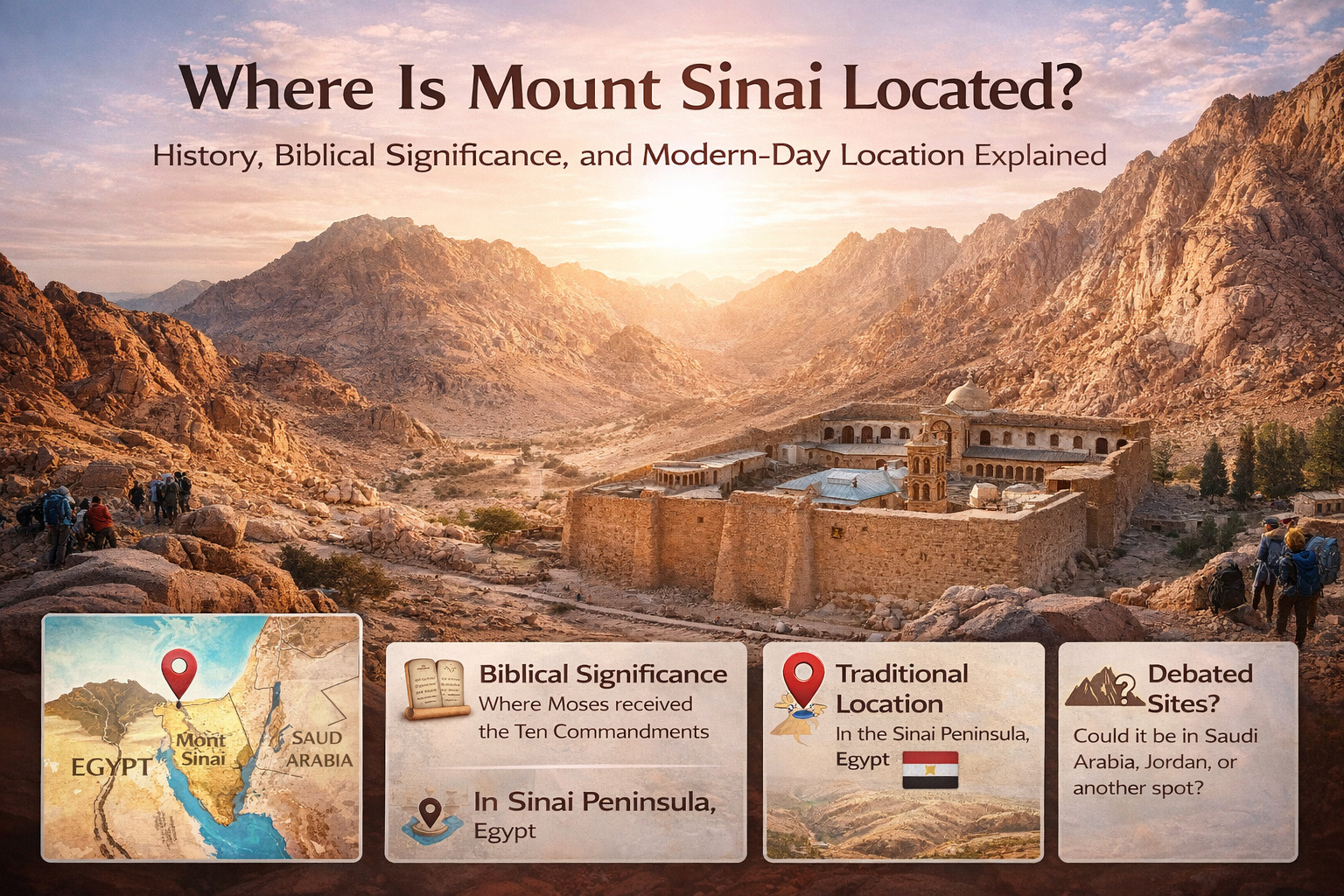
Where Is Mount Sinai Located? History, Biblical Significance, and Modern-Day Location Explained
Published: April 2026 | Main Keyword: Where is Mount Sinai Located | Reading time: ~20 minutes
Here’s a question that sounds simple but has baffled scholars, archaeologists, pilgrims, and theologians for more than three thousand years: Where, exactly, is Mount Sinai? You might assume this is settled history. It isn’t. And the reason it isn’t is one of the most fascinating detective stories in the ancient world.
For billions of people across three of the world’s great religions, Judaism, Christianity, and Islam, Mount Sinai is the most consequential mountain on earth. It’s the place where Moses received the Ten Commandments. Where God descended in fire and thunder. Where a covenant was made that shaped the moral architecture of Western civilisation and beyond. Yet stand on a modern map and try to pin it down precisely, and you’ll find four or five serious competing locations, each with its own scholars, evidence, and passionate advocates.
This pillar guide covers everything: the traditional location of Mount Sinai (Jebel Musa in Egypt’s Sinai Peninsula), the leading alternative theories, the deep biblical and historical significance of the mountain, its modern-day geography, what Saint Catherine’s Monastery is and why it matters, and a practical guide for anyone planning to visit. We’ll also tackle the most common questions people ask from Google searches to voice assistants to AI engines about one of humanity’s most sacred sites.
QUICK ANSWER: Mount Sinai is traditionally identified with Jebel Musa (Arabic: ‘Mountain of Moses’), a 2,285-meter (7,497 ft) granite peak located in the south-central Sinai Peninsula of Egypt, near the city of Saint Catherine. It is revered as the site where, according to the Torah, the Bible, and the Quran, the Hebrew prophet Moses received the Ten Commandments from God. The exact identification of the biblical Mount Sinai remains debated among scholars, with competing sites proposed in Egypt, Saudi Arabia, and Israel.
Where Is Mount Sinai Located? The Modern-Day Geography
Let’s start with what we can say with certainty about the physical location.
The mountain traditionally identified as Mount Sinai sits in South Sinai Governorate (Janub Sina), Egypt, on the Sinai Peninsula, the distinctive triangular landmass that serves as a land bridge between Africa and Asia. The peninsula is bounded to the west by the Gulf of Suez and the Suez Canal, and to the east by the Gulf of Aqaba. The mountain rises to 2,285 metres (7,497 feet) above sea level and is known in Arabic as Jabal Musa, literally, ‘Mountain of Moses.’
According to Encyclopaedia Britannica, the mountain is situated in the south-central region of the Sinai Peninsula and has long been accepted as the traditional site of divine revelation in Jewish, Christian, and Islamic tradition. It is surrounded on all sides by higher peaks, notably Mount Catherine (Jabal Katrina), which at 2,629 metres (8,625 ft) is the tallest mountain in Egypt. Worth noting: Mount Sinai’s own height is not exceptional for the region. What makes it extraordinary is entirely theological, not topographical.
Key Geographic Facts at a Glance
| Part of the Saint Catherine Area, a World Heritage Site since 2002 | Detail |
| Arabic name | Jabal Musa (Mountain of Moses) |
| Location | South Sinai Peninsula, Egypt |
| Nearest city | Saint Catherine, South Sinai Governorate |
| Elevation | 2,285 m / 7,497 ft above sea level |
| Closest major city | Cairo (~500 km northwest); Sharm el-Sheikh (~200 km south) |
| Coordinates | 28 deg 32 N, 33 deg 58 E (approx.) |
| UNESCO status | Part of Saint Catherine Area, World Heritage Site since 2002 |
| Airport | St. Catherine International Airport (SKV), ~20 km from the monastery |
Getting there: Modern visitors reach Sinai by road from Cairo through the Suez Canal, a journey of roughly five to eight hours. Alternatively, flights connect to St. Catherine International Airport, or visitors can approach from the south via the Red Sea resort town of Sharm el-Sheikh, approximately a three-hour drive. UNESCO’s World Heritage listing covers both the monastery and the surrounding sacred landscape.
The Biblical Account: What the Scriptures Say Happened at Mount Sinai
Before we can understand the significance of Mount Sinai’s location, we need to understand what the texts say happened there because it’s not just one event. Mount Sinai is the setting for some of the most dramatic chapters in the Hebrew Bible, and its theological weight reverberates across the entire Abrahamic tradition.
The Burning Bush: The First Encounter (Exodus 3)
Moses’ first encounter with God on Mount Sinai actually preceded the Exodus. As recorded in Exodus 3:1-2, Moses was tending his father-in-law Jethro’s flocks in the backside of the desert, and led them to ‘the mountain of God, even to Horeb.’ There, an angel of the Lord appeared to him in a flame of fire from the midst of a thornbush, a bush that burned but was not consumed. This is the moment God commissioned Moses to return to Egypt and lead the Israelites to freedom.
Note the name ‘Horeb.’ Many biblical scholars treat Horeb and Sinai as two names for the same mountain, Sinai, used predominantly in the Pentateuch’s Jahwist and Priestly sources, Horeb in Deuteronomy and the Elohist source. This dual naming has contributed significantly to location debates over the centuries.
The Covenant and the Ten Commandments (Exodus 19-24)
The central event at Mount Sinai was the giving of the Law recorded across Exodus chapters 19 through 24. The account is one of overwhelming sensory drama: thunder, lightning, a thick cloud covering the mountain, the sound of a trumpet growing louder, the mountain quaking, fire and smoke rising as from a furnace. The Israelites camped at the foot of the mountain were forbidden from even touching it under penalty of death.
According to Wikipedia’s analysis of the biblical Mount Sinai, Moses stayed on the mountain for 40 days and 40 nights to receive the Ten Commandments and did so twice, because he shattered the first set of Tablets of Stone in anger when he descended to find the Israelites worshipping a golden calf. The second set, written by God’s own hand according to Exodus 31:18, was the covenant text that would define Israel’s relationship with its God for generations.
“When the LORD finished speaking to Moses on Mount Sinai, he gave him the two tablets of the covenant law, the tablets of stone inscribed by the finger of God.” – Exodus 31:18
The Tabernacle Instructions, the Priestly Code, and More
Most people know the Ten Commandments story. Fewer realise that Mount Sinai is the setting for three and a half of the first five books of the Bible: Exodus, Leviticus, Numbers, and part of Deuteronomy. The detailed instructions for the construction of the Tabernacle (the portable sanctuary housing the Ark of the Covenant), the system of priestly worship, the laws of purity, the dietary laws, and the agricultural festivals,s all of it was revealed at Sinai. According to rabbinic tradition, not just the written Torah but the entire oral Torah was also transmitted to Moses there.
Elijah at Horeb: A Second Major Theophany (1 Kings 19)
About 600 years after Moses, another prophet came to this mountain. Elijah, fleeing threats on his life from Queen Jezebel, travelled forty days to reach ‘Horeb, the mountain of God.’ There, exhausted and despairing in a cave, he heard the famous ‘still small voice’ of God, a deliberate contrast to the spectacular fire, earthquake, and wind that preceded it. This encounter at the same sacred mountain connects Moses and Elijah as the two great prophets of Israel, which is why both appear alongside Jesus in the New Testament’s Transfiguration account.
Mount Sinai in the New Testament and the Quran
In the New Testament, Paul’s letter to the Galatians (4:24-25) uses Mount Sinai as a theological metaphor, contrasting the slavery of the Law symbolised by Hagar and Sinai) with the freedom of grace (symbolised by Sarah and the heavenly Jerusalem). The book of Hebrews (12:18-22) similarly contrasts the terrifying fire-and-darkness mountain of the old covenant with Mount Zion, the mountain of the new covenant in Christ.
In Islam, the Quran refers to Mount Sinai in multiple places using the names Tur Sina, Tur Sinin, and al-Tur. The mountain is called a muqaddas (sacred) location, and the adjacent valley,y Wadi Tuwa, is specifically described as ‘the blessed place.’ Jabal Musa remains an important pilgrimage site for Muslims to this day, with a mosque still active at the summit alongside the Greek Orthodox chapel.
The Location Debate: Where Is the REAL Mount Sinai?
Here’s where it gets genuinely fascinating, nd honestly, a little contentious. The exact location of the biblical Mount Sinai is one of archaeology’s most enduring open questions. No single site has been confirmed beyond a reasonable doubt. Here are the main competing theories.
Theory 1: Jebel Musa – The Traditional Site (South Sinai Peninsula, Egypt)
The most widely accepted candidate is Jebel Musa in the south-central Sinai Peninsula. This identification became established in early Christian tradition from around the 3rd century AD onward, with the earliest known pilgrimage accounts recorded by Egeria, a Christian woman pilgrim who visited in 381-384 AD. The monastery of Saint Catherine was built at the foot of this mountain between 548 and 565 AD by order of Byzantine Emperor Justinian I, institutionalising the identification for all time.
Per GotQuestions.org’s scholarly overview, the traditional site has an elevation of 7,497 feet above sea level, and its ancient library was the source of the Codex Sinaiticus, cus one of the most important Greek manuscripts used in Bible translation, dating from the 4th century AD.
Why scholars accept it: Centuries of unbroken pilgrimage tradition, the monastery’s continuous habitation since the 6th century, geographic plausibility with the Exodus route, and the presence of the Codex Sinaiticus.
Why some doubt it: The identification was solidified 1,000+ years after the events. The mountain’s height is unremarkable for the region. Archaeological evidence for a large Israelite encampment is absent.
Theory 2: Jabal al-Lawz – The Saudi Arabia Hypothesis
A vocal minority of researchers, including some evangelical explorers and the controversial documentary filmmaker Joel Richardson,rdson argue that the true Mount Sinai lies at Jabal al-Lawz (or Jebel el-Lawz) in northwestern Saudi Arabia, in the ancient region of Midian. The key argument draws on Galatians 4:25, where Paul writes that ‘Mount Sinai is in Arabia.’ Some archaeologists have pointed to blackened rock at the summit (suggesting scorching by fire) and ancient petroglyphs in the area as potential supporting evidence.
Supporting argument: Moses fled to Midian (in modern Saudi Arabia) before the burning bush encounter. Paul explicitly locates Sinai ‘in Arabia.’ Topographic features at Jabal al-Lawz, including a split rock formation some identify with Exodus 17, have attracted attention.
Counter-argument: The ancient term ‘Arabia’ covered a far broader geographic region than modern Saudi Arabia, which included the Sinai Peninsula. Saudi authorities have restricted access to Jabal al-Lawz, limiting independent archaeological verification.
Theory 3: Har Karkom The Negev Desert Hypothesis (Israel)
Italian archaeologist Emmanuel Anati spent decades arguing that the biblical Mount Sinai is Har Karkom, a 2,700-foot plateau ridge in the southern Negev Desert of Israel. His argument centres on the extraordinary concentration of rock art and ancient religious sites in the area, over 1,200 rock engraving sites, which he believes correspond to the biblical descriptions of Israel’s encampment.
Supporting argument: Dense archaeological evidence of ancient religious activity; proximity to the plausible route of an Exodus from Egypt; rock art that Anati believes has biblical motifs.
Counter-argument: Anati’s proposed dating of the events (3rd millennium BC rather than the conventional ~1446-1200 BC) is widely rejected. The route requires crossing into modern Israel, complicating the textual geography.
Theory 4: Other Sites in the Sinai Peninsula
Additional proposals have placed the mountain at Mount Serbal (the fifth-highest mountain in Egypt, favoured by the earliest Christian tradition before Jebel Musa displaced it), and Mount Yeroham in the northern Negev. Each has its advocates and its problems.
The honest assessment? As GotQuestions.org puts it plainly: no one really knows for sure. The traditional site at Jebel Musa is supported by the longest and most continuous body of tradition. But tradition is not the same as proof. The debate is genuinely open, and that’s not a failure of scholarship. It’s a reflection of how ancient these events are, and how much the ancient world has changed.
| Location | Country | Elevation | Support Level | Key Evidence |
| Jebel Musa (Traditional) | Egypt | 2,285 m / 7,497 ft | Strongest tradition | St. Catherine Monastery; centuries of pilgrimage; Codex Sinaiticus |
| Jabal al-Lawz | Saudi Arabia | ~2,580 m / 8,465 ft | Minority view | Galatians 4:25; proximity to Midian; blackened summit rocks |
| Har Karkom | Israel (Negev) | ~850 m / 2,790 ft | Academic minority | Dense rock art; ancient campsites nearby |
| Mount Serbal | Egypt (Sinai) | ~2,070 m / 6,791 ft | Historical (pre-6th c.) | Earliest Christian tradition before Jebel Musa |
Saint Catherine’s Monastery: The Ancient Guardian at the Foot of Mount Sinai
If Mount Sinai is the most theologically significant mountain in the world, then Saint Catherine’s Monastery, nestled at its foot, might be the most historically significant building. And ‘building’ barely does it justice.
The World’s Oldest Continuously Inhabited Monastery
Saint Catherine’s was built between 548 and 565 AD by order of Byzantine Emperor Justinian I. It has been in continuous habitation and use for its original purpose, Christian monastic life, for roughly 1,500 years without interruption. Wars have swept through the region. Empires have risen and fallen. And yet the monks have remained. According to Britannica, the monastery has never been destroyed throughout its entire history.
The monastery was built to enclose what is claimed to be the original Burning Bush seen by Moses. The bush still grows within the monastery grounds today, and according to horticultural analysis, it is of a species (Rubus sanctus) not found naturally anywhere else in the Sinai region, which the monks take as evidence of its singularity. UNESCO designated the monastery and its surroundings a World Heritage Site in 2002 for its unique importance to Judaism, Christianity, and Islam.
“The monastery has never been destroyed in all its history, and thus it can be said to have preserved intact the distinctive qualities of its Greek and Roman heritage.” – Saint Catherine’s Monastery official website.
The Library: The World’s Oldest Continuously Operating Library
Here is a fact that deserves to stop you cold: the library at Saint Catherine’s, founded sometime between 527 and 565 AD, holds the Guinness World Record as the world’s oldest continuously operating library. It preserves the world’s second-largest collection of early codices and manuscripts after the Vatican Library in Greek, Arabic, Syriac, Georgian, Armenian, Coptic, Church Slavonic, Latin, and other languages.
The library’s crown jewel was the Codex Sinaiticus,s a near-complete 4th-century Greek manuscript of the Bible, discovered by German scholar Constantin von Tischendorf during visits in 1844 and 1859. It is now held in the British Museum, a circumstance that remains sensitive. The library also houses the Codex Syriacus, a Syriac text of the Gospels written around 400 AD, and over 4,500 priceless manuscripts in total.
In 1975, workmen accidentally uncovered a hidden room behind a wall, revealing approximately 3,000 additional manuscripts, ts including missing portions of the Codex Sinaiticus and dozens of previously unknown ancient texts. A discovery of that magnitude, in 1975, in a building that had already been continuously occupied for 1,400 years. That’s the kind of place this is.
The Art Collection: The Most Important Pre-Iconoclastic Icons in Existence
Saint Catherine’s houses the most significant collection of early Christian icons in the world, particularly icons that predate the Iconoclastic controversy of the 8th-9th centuries, during which Byzantine emperors tried to destroy all religious images. Because the Sinai Peninsula was under Islamic control at the time (and the monastery had a protective firmán from Muhammad himself), its icons escaped destruction. The result is an irreplaceable window into early Christian art that exists nowhere else.
The collection includes a 6th-century encaustic icon of Christ, possibly the oldest icon of Jesus in existence, painted with such vivid naturalism that art historians believe it was made in Constantinople itself.
Practical Visitor Information for Saint Catherine’s
- Opening hours: Monday–Thursday and Saturday, 9:00 AM – 11:30 AM only (closed Fridays, Sundays, and Orthodox holidays)
- Dress code: Shoulders and knees must be covered. No shorts.
- Access: No admission fee for the monastery; there is a charge for the museum
- Guided tours: Highly recommended; Bedouin guides are required by law for the mountain hike
- From Cairo: ~5-8 hours by road through the Suez Canal route
- From Sharm el-Sheikh: ~3 hours by road
- Best time to visit: October to April (summers are extremely hot and dry)
- Safety note: The U.S. State Department maintains a Level 4 advisory for most of the Sinai Peninsula; however, the Saint Catherine area is generally considered safe for tourism. Verify current advisories before travel.
Mount Sinai in Three Religions: Why It Matters to 4 Billion People
Here is what makes Mount Sinai genuinely singular among the world’s sacred sites: it is holy to all three Abrahamic religions simultaneously, and not merely nominally. Each tradition has a living, active relationship with this mountain.
Judaism: The Birthplace of the Nation
For Judaism, Mount Sinai is the most theologically loaded location in Scripture after the Land of Israel itself. It is where God entered into a formal covenant,t a binding legal relationship, with the entire people of Israel. The Talmud and later rabbinic literature devote enormous attention to the events at Sinai. The rabbis also give the mountain three additional Hebrew names that reveal its significance: Har ha-Elohim (‘Mountain of God’), Har Bashan (‘with the teeth’ symbolising divine sustenance), and Har Gabnunim (‘mountain of the sword,’ because the Sanhedrin’s power of capital judgment was rooted in the Sinaitic law).
According to rabbinic tradition, not only the written Torah (the five books of Moses) but the entire oral Torah, the chain of interpretive tradition eventually written down in the Mishnah and Talmud, was transmitted to Moses at Sinai. This makes the mountain not just a historical event but a living source of Jewish law and practice to this day.
Christianity: The Mountain of Law and Its Transformation
Early Christians revered Mount Sinai as the place where God’s direct relationship with humanity was established through law, even as Christian theology came to see that law as a shadow pointing toward the grace of Christ. The ascetic Christians who settled the Sinai region from the 3rd century onward were drawn to the mountain’s spiritual intensity. Their presence eventually led to Saint Catherine’s Monastery.
In Christian theological reading, Mount Sinai carries a note of both awe and limitation. The book of Hebrews contrasts the ‘blazing fire and darkness and gloom and whirlwind’ of Sina, the unapproachable, terrifying, with Mount Zion and the new covenant accessible through Christ. Paul’s Galatians allegory uses Sinai to represent the bondage of those who try to earn righteousness through rule-following. The mountain, in other words, is not discarded in Christian thought; it is fulfilled and transcended.
Islam: A Deeply Honoured Sacred Site
The Quran references Mount Sinai with multiple honorific names and identifies it as a muqaddas holy ground. The Prophet Musa (Moses) is one of the most significant prophets in Islam, and his encounter with God on the mountain is explicitly affirmed. In 637 AD, Islamic Caliph Umar ibn al-Khattab captured the mountain, and it has been an important pilgrimage site for Muslims ever since. The mosque at the summit of Jebel Musa is still actively used. Saint Catherine’s Monastery itself contains a Fatimid mosque built in 1106 AD that is still preserved as a remarkable symbol of religious coexistence spanning nearly a millennium.
“Mount Sinai is important because it is a holy site for Jews, Christians, and Muslims alike.” – TouristEgypt.com
How to Visit Mount Sinai Today: A Practical Step-by-Step Guide
Visiting Mount Sinai is one of the most profound travel experiences available on earth. It’s also genuinely challenging. Here’s what you need to know.
The Sunrise Hike: The Classic Experience
The traditional way to experience Mount Sinai is a nighttime hike, timed to reach the summit at sunrise. It sounds romantic. It is, but it also involves starting around 2:00 AM, hiking in darkness for two to three hours at altitude, arriving at temperatures well below freezing (even in spring and autumn), and navigating 750 rough stone steps at the end. Real visitors in January 2026 reported that the stars on the way up were ‘bright and amazing’ and that renting a heavy wool blanket at the top and waiting in a Bedouin tent was essential.
- Book accommodation in Saint Catherine’s town or at a nearby guesthouse the night before.
- Hire a certified Bedouin guide required by Egyptian law and essential for navigation in the dark.
- Pack: warm layers (temperatures at the summit can be near freezing at night), water, a headlamp, and snacks. Bedouin-run tea shelters exist partway up.
- Start the hike around 2:00-3:00 AM to reach the 2,285 m summit at sunrise.
- 750 rough stone steps mark the final ascent, steep and demanding. Camels are available for hire for part of the lower route.
- After the descent, visit Saint Catherine’s Monastery, which opens at 9:00 AM.
What to See at the Monastery
- The Chapel of the Burning Bush -remove your shoes before entering, as God commanded Mose.s
- The Well of Moses – still functioning, with water used by the monastic community
- The Basilica of the Transfiguration – monks have worshipped here for 1,400 years
- The Monastery Museum – icons, manuscripts, precious chalices; some artifacts dating to the 5th and 6th centuries
- The Charnel House (Ossuary) – outside the main walls; it contains the skeletal remains of centuries of monks.
- Codex Sinaiticus replica display – the original is in the British Museum
Travel Logistics
The closest international airports are Cairo (CAI) and Sharm el-Sheikh (SSH). St. Catherine International Airport (SKV) handles some domestic and regional flights. Most visitors travel by road from Cairo (5-8 hours) or Sharm el-Sheikh (~3 hours). Tour operators in both citieoffer organiseddd Mount Sinai packages including transport, guide, accommodation, and sunrise hike.
Frequently Asked Questions About Mount Sinai
Where is Mount Sinai in Egypt exactly?
Mount Sinai (Jebel Musa) is located in the South Sinai Governorate (Janub Sina) of Egypt, in the south-central portion of the Sinai Peninsula, near the town of Saint Catherine. It sits at coordinates approximately 28 degrees 32 N, 33 degrees 58 E, and rises to 2,285 metres (7,497 feet) above sea level.
Is Mount Sinai the same as Mount Horeb?
Most biblical scholars believe that Sinai and Horeb refer to the same mountain. The two names appear to come from different documentary sources: ‘Sinai’ is used predominantly in the Jahwist and Priestly texts, ‘Horeb’ in the Elohist and Deuteronomy. Both clearly describe the same sacred mountain where God appeared to Moses and the Ten Commandments were given.
Can you still visit Mount Sinai today?
Yes, Mount Sinai is open to visitors. Tourists regularly hike the mountain, especially for the sunrise experience. Saint Catherine’s Monastery at the foot of the mountain is open five days a week (Monday-Thursday and Saturday) from 9:00 AM to 11:30 AM. A Bedouin guide is legally required for the mountain hike. Check current travel advisories before visiting,g as the broader Sinai Peninsula has areas of security concern.
What is the significance of Mount Sinai in the Bible?
Mount Sinai is the central location of divine revelation in the Hebrew Bible, the site where Moses received the Ten Commandments and the entire body of Mosaic Law, where God entered into a formal covenant with Israel, and where the blueprints for the Tabernacle (the portable divine sanctuary) were given. The mountain is the theological anchor of Judaism, features in both Protestant and Catholic Christian theology as the mountain of law, and is a sacred pilgrimage site in Islam.
Why is the location of Mount Sinai debated?
The location is debated because no archaeological evidence conclusively identifies a single site, the geographic place-names in the Exodus narrative cannot be matched with certainty to modern locations, and the events described occurred roughly 3,000-3,500 years ago. The traditional identification with Jebel Musa in Egypt has the strongest and most continuous chain of tradition, but it was established over 1,000 years after the biblical events.
How tall is Mount Sinai?
The traditional Mount Sinai (Jebel Musa) stands at 2,285 metres (7,497 feet) above sea level. It is surrounded by higher peaks in the same range,nge notably Mount Catherine (Jabal Katrina) at 2,629 metres (8,625 feet), which is the tallest mountain in Egypt. If the Saudi Arabia identification (Jabal al-Lawz) is correct, that peak reaches approximately 2,580 metres (8,465 feet).
What is Saint Catherine’sMonasterys,tery and why is it important?
Saint Catherine’s Monastery is a Greek Orthodox Christian monastery built between 548 and 565 AD at the foot of Mount Sinai (Jebel Musa) in Egypt. It is the world’s oldest continuously inhabited Christian monastery and holds the Guinness World Record as the oldest continuously operating library. It houses the world’s second-largest collection of early manuscripts (after the Vatican), over 2,000 icons, including some of the oldest Christian icons in existence and was designated a UNESCO World Heritage Site in 2002.
Key Resources
External Authoritative Sources
- Mount Sinai – Encyclopaedia Britannica
- Mount Sinai (Bible) – Wikipedia
- Saint Catherine’s Area – UNESCO World Heritage Centre
- Saint Catherine’s Monastery Official Website
- Saint Catherine’s Monastery – Britannica
- Mount Sinai location debate – GotQuestions.org
- Art and architecture of Saint Catherine’s – Smarthistory