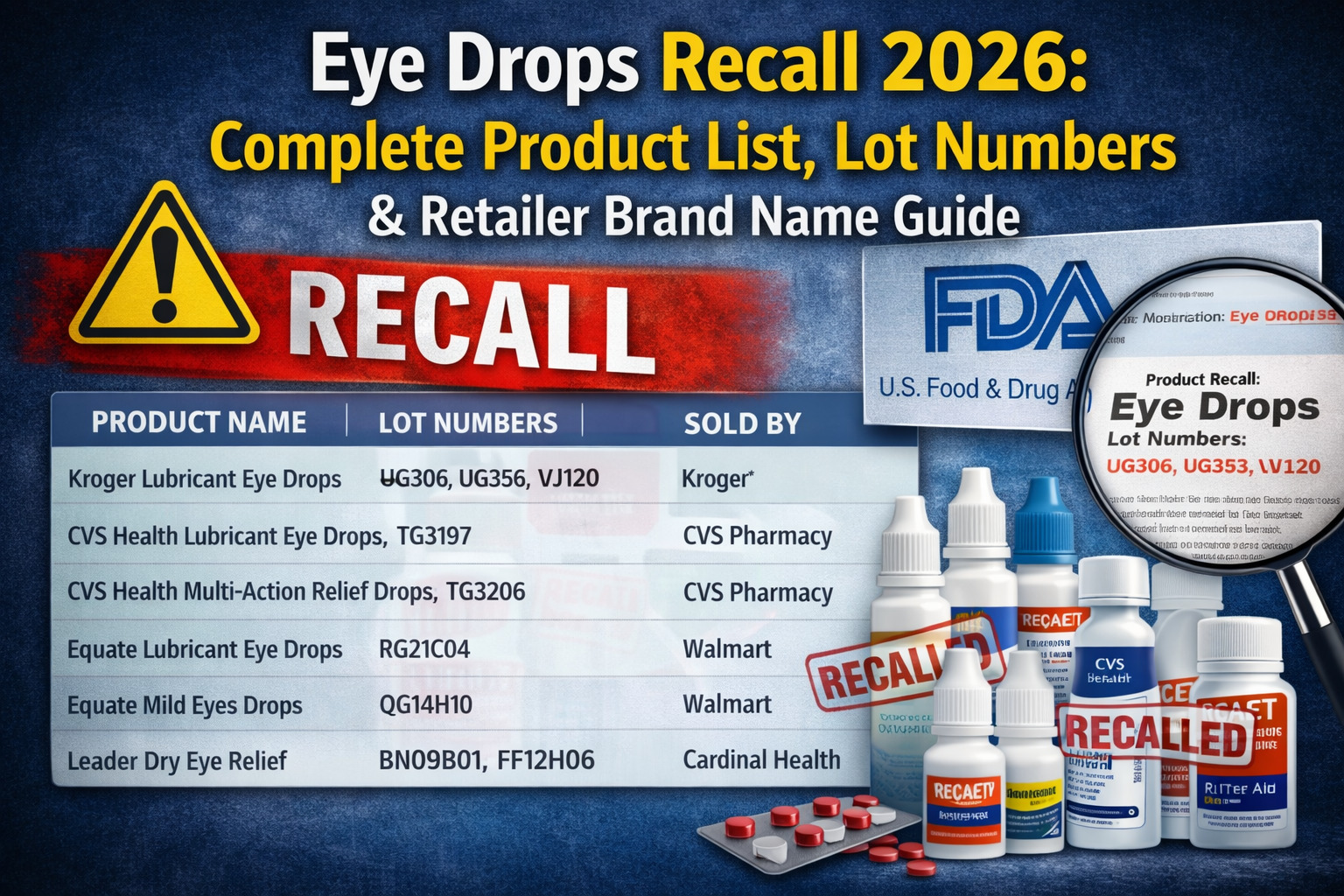
Eye Drops Recall 2026: Complete Product List, Lot Numbers & Retailer Brand Name Guide
Eye Drops Recall 2026: Complete Product List, Lot Numbers & Retailer Brand Name Guide
Consumer Safety Reference · Eye Drops Recall 2026 · Updated April 4, 2026
Eye Drops Recall 2026: Main Guide › Complete Product List & Retailer Reference
⚠ ACTIVE RECALL FDA Event ID 98533 · Recall Numbers D-0409-2026 through D-0416-2026 · 3,111,072 units affected nationwide· Detailed Eye Drops – Recall 2026
Everything in one place: all 8 recalled product types, their exact formulas, known lot code prefixes, expiration ranges, which store-brand names to look for at each major retailer, and exactly what to do if you find a match.
Reference compiled: April 4, 2026Source: FDA Enforcement Reports D-0409-2026 through D-0416-2026Manufacturer: K.C. Pharmaceuticals, Inc., Pomona, California
⛔ Quick Summary: What You Need to Know
KC Pharmaceuticals voluntarily recalled 3,111,072 bottles of OTC eye drops on March 3, 2026. The FDA classified it as a Class II recall on March 31, 2026. Reason: “lack of assurance of sterility.” No confirmed contamination. No injuries reported as of April 4, 2026. Products have been sold at 15+ major U.S. retailers under different store-brand names.
🔍 3-Step Bottle Check: Is Your Product Recalled?
Grab your eye drop bottle and follow these steps. It takes under two minutes.
- 1 Check the product name. Look at the front label. Does it say: Dry Eye Relief, Artificial Tears, Advanced Relief, Ultra Lubricating, Redness Lubricant, Soothing Tears, or Original Formula? These generic-sounding names under any store brand may be affected.
- 2 Check the lot code. It’s usually on the bottom or back of the bottle near the expiration date. If the code starts with AC, AR, LT, SU, RG, RL, SY, or AT, proceed to step 3.
- 3 Check the expiration date. Affected lots expire between April 30 and October 31, 2026. If your bottle matches on all three counts, stop using it, set it aside, and return it to the retailer for a refund.
Still unsure? The most authoritative check is the FDA’s official recall database, where you can search by the recall numbers or NDC codes listed below.
📌 Parent Article: Eye Drops Recall 2026: Full Consumer Guide – Includes the medical explanation of sterility failures, the 2023 precedent case, expert commentary, and full FAQ.
All 8 Recalled Eye Drop Products: Full Detail
KC Pharmaceuticals produced eight distinct OTC eye drop formulas that are included in this recall. Each product has a different active ingredient combination designed for specific uses, ranging from redness relief to dry eye lubrication. Here’s the complete breakdown:
| See the FDA report | Product Name (Generic) | Active Ingredients | Size | Est. Units | Lot Prefix | Recall Status |
|---|---|---|---|---|---|---|
| 1 | Sterile Eye Drops AC | Tetrahydrozoline HCl 0.05%, Zinc Sulfate 0.25% | 15 mL | 182,424 | AC24E01 | Recalled |
| 2 | Eye Drops Advanced Relief | Dextran 70 0.1%, PEG 400 1%, Tetrahydrozoline HCl 0.05% | 15 mL | 303,216 | AR prefix | Recalled |
| 3 | Dry Eye Relief Eye Drops | Glycerin 0.2%, Hypromellose 0.2%, PEG 400 1% | 15 mL | 1,023,096 | LT prefix | Recalled |
| 4 | Ultra Lubricating Eye Drops | Polyethylene Glycol 400 0.4%, Propylene Glycol 0.3% | 15 mL | See FDA report | SU prefix | Recalled |
| 5 | Sterile Eye Drops Original Formula | Tetrahydrozoline HCl 0.05% | 15 mL | See FDA report | RG prefix | Recalled |
| 6 | Sterile Eye Drops Redness Lubricant | Glycerin 0.25%, Naphazoline HCl 0.012% | 15 mL | See FDA report | RL prefix | Recalled |
| 7 | Sterile Eye Drops Soothing Tears | PEG 400 0.4%, Propylene Glycol 0.3% | 15 mL | See FDA report | SY prefix | Recalled |
| 8 | Artificial Tears Sterile Lubricant Eye Drops | Polyvinyl Alcohol 0.5%, Povidone 0.6% | 15 mL | See FDA report | AT prefix | Recalled |
⚠️ Expiration Date Range for Affected Lots
Recalled lots have expiration dates in the following range:
Exp: 04/30/2026Exp: 05/31/2026Exp: 07/31/2026Exp: 10/31/2026
For the complete, authoritative list of every lot code and NDC number, download or view the FDA enforcement report (Event ID 98533).
The largest single product recalled is the Dry Eye Relief Eye Drops, at over 1 million units,s nearly a third of the entire recall by volume. This product, CT in particular, lar was sold under many retailers’ private labels and was the most widely distributed of the eight formulas.
Retailer-Specific Brand Name Guide: What to Look For at Each Store
This is the part that trips most people up. The products are sold under different names at different stores, but they’re the same recalled formula underneath. Here’s how to identify the affected product at each major retailer:
💊 Walgreens
| Walgreens Dry Eye Relief | Matches recalled “Dry Eye Relief Eye Drops” formula |
| Walgreens Lubricant Eye Drops Redness Reliever | Matches recalled “Redness Lubricant” formula |
| Walgreens Artificial Tears | Matches recalled “Artificial Tears Sterile Lubricant” formula |
| Walgreens Advanced Relief Eye Drops | Matches recalled “Advanced Relief” formula |
💊 CVS Health
| The two-pack version is also recalled | Matches recalled “Dry Eye Relief” formula CVS confirmed discontinuation nearly a year ago |
| CVS Lubricant Eye Drops Redness Reliever | Matches recalled “Redness Lubricant” formula |
| CVS Lubricant Eye Drops Redness Reliever (2-pack) | Two-pack version also recalled |
| CVS Artificial Tears | Matches recalled “Artificial Tears” formula |
🛒 Kroger
| Kroger Dry Eye Relief Eye Drops | Matches recalled “Dry Eye Relief” formula |
| Kroger Lubricant Eye Drops | Matches recalled “Ultra Lubricating” formula |
| Kroger Artificial Tears | Matches recalled “Artificial Tears” formula |
💊 Rite Aid
| Rite Aid Dry Eye Relief Eye Drops | Matches recalled “Dry Eye Relief” formula |
| Rite Aid Lubricant Eye Drops | Matches recalled “Ultra Lubricating” formula |
| Rite Aid Artificial Tears | Matches recalled “Artificial Tears” formula |
🛒 H-E-B
| H-E-B Dry Eye Relief Eye Drops | Matches recalled “Dry Eye Relief” formula |
| H-E-B Lubricant Eye Drops | May match recalled formulas verify by lot code |
🛒 Publix / Harris Teeter / Meijer
| Store-brand Dry Eye Relief | Verify by manufacturer: KC Pharmaceuticals, Pomona CA |
| Store-brand Artificial Tears / Lubricant Eye Drops | Verify by lot code prefix and expiration date |
🏥 Wholesale / Distribution Brands
| Included in the recalled distribution network | Check for KC Pharmaceuticals manufacturer imprint |
| Leader Brand (Cardinal Health) | Distributed through Cardinal Health included in recall |
| Good Sense | Check manufacturer and lot code |
| Gericare | Included in recalled distribution network |
| Best Choice | Included in recalled distribution network |
📋 How to Confirm the Manufacturer on Any Bottle
Turn the bottle to the back label and look for the “Manufactured by” or “Distributed by” line. If it reads “K.C. Pharmaceuticals, Inc., Pomona, CA” or “KC Pharmaceuticals” and the product name matches one of the eight recalled formulas, treat it as potentially recalled and check the lot code.
Step-by-Step: What to Do With a Recalled Bottle
Found a match? Don’t panic — but don’t delay either. Here’s what to do:
| File a report with the FDA MedWatch if you experienced problems | Action | Notes |
|---|---|---|
| 1. Stop using it | Set the bottle aside immediately | Don’t finish the bottle even if you feel fine. You can’t see contamination. |
| 2. Don’t share it | Don’t give it to a family member, friend, or pet | Eye drops contaminated with bacteria can spread infections easily |
| 3. Return it | Bring to the store where you purchased it | CVS, Walgreens, Kroger and others are accepting returns without receipt for recalled products |
| 4. Monitor symptoms | Watch for redness, discharge, vision changes, or pain | If symptoms appear, see an eye doctor promptly — don’t wait |
| 5. Report adverse effects | File a report with FDA MedWatch if you experienced problems | MedWatch Online Reporting Form |
✅ Return Policy Confirmed by Major Retailers
CVS has publicly confirmed that recalled products may be returned to any CVS Pharmacy for a full refund. Walgreens and Kroger operate under the same general policy for safety recalls, no receipt required. If a store refuses a return, escalate to the retailer’s customer service line or contact the FDA directly.
Safe Alternatives: What to Use Instead
If you rely on artificial tears or lubricating eye drops regularly, especially if you have chronic dry eye disease, wear contact lenses, or have had recent eye surgery, you need a safe replacement quickly. Here are some options not involved in this recall (as of April 4, 2026):
| Chronic dry eye requires prescription; consult your eye doctor | Product Type | Notes |
|---|---|---|
| Refresh Tears (Allergan/AbbVie) | Lubricating artificial tears | Widely available; established manufacturer; not part of this recall |
| Systane Ultra (Alcon) | Extended protection dry eye drops | Alcon is a major ophthalmology company; not affected by this recall |
| Blink Tears (Johnson & Johnson) | Lubricating eye drops | Available OTC at most pharmacies; not part of this recall |
| TheraTears | Dry eye therapy drops | Electrolyte-balanced formula; not affected |
| Prescription alternatives | e.g., Restasis, Xiidra, Cequa | For chronic dry eye requires prescription; consult your eye doctor |
⚠️ Important: Avoid “Natural” or “Homeopathic” Eye Drops
Consumer safety advocates warn against using products marketed as “natural,” “organic,” or “homeopathic” eye drops. The FDA does not regulate these the same way it does conventional OTC eye drops, meaning their manufacturing sterility may not be guaranteed. If a product is eye drops and doesn’t say “FDA-regulated” or list approved OTC active ingredients, skip it.
Who Is KC Pharmaceuticals? Understanding the Manufacturer
Most consumers have never heard of K.C. Pharmaceuticals, Inc., and that’s by design. Private label manufacturers like KC Pharma operate entirely in the background, producing the actual product while retailers brand and sell it under their own names.
KC Pharmaceuticals, based in Pomona, California, describes itself as the largest private-label eye care supplier in North America. According to reporting by UPI, the company services 26 of the top 30 U.S. retailers and more than 90,000 stores across the country. That scale explains why a single quality control issue cascades into millions of affected units across dozens of retailer names simultaneously.
The company has not issued a public statement explaining the root cause of the sterility assurance failure. As of April 4, 2026, no official press release has been issued by the firm regarding this recall, according to FDA records. The FDA notice itself does not specify whether the issue originated in the manufacturing environment, the sterilization process, or packaging integrity, only that the assurance of sterility could not be confirmed.
This opacity is unfortunately common in Class II voluntary recalls, where the regulatory requirement is disclosure and removal from shelves rather than a detailed public autopsy of what went wrong. For consumers, it means trusting the lot code and NDC system to identify affected products, which is why the FDA’s complete enforcement report remains the definitive reference.
Frequently Asked Questions
How do I find the lot code on my eye drops bottle?
The lot code is usually printed on the bottom or back of the bottle, often near or alongside the expiration date. It may be preceded by “LOT:” or “Lot No.” On small 15 mL (0.5 fl oz) bottles, it’s sometimes embossed or printed in small text along the bottle crimp or cap area. If you can’t find it, check under a bright light. Lott codes can be hard to read on clear bottles.
My bottle says “Sterile” on the label – is it still recalled?
Yes, possibly. The recall phrase “lack of assurance of sterility” means the manufacturing process couldn’t guarantee sterility, even if “sterile” appears on the label. The label claim reflects what the product is supposed to be, not what was confirmed about the specific batch. Always verify by lot code and recall number, not label language.
Is this recall still active as of April 2026?
Yes. As of April 4, 2026, the FDA has not listed a termination date for recall numbers D-0409-2026 through D-0416-2026. The recall remains ongoing. Check the FDA’s official enforcement database for status updates.
Can I still use my recalled eye drops until I can get to a store?
For Class II recalls, the FDA does not categorically instruct consumers to stop using affected products unless the manufacturer specifies otherwise. However, the medical consensus from ophthalmologists is that you should stop using any recalled ophthalmic product as soon as you identify it, because the potential for eye infection, even if remote, is not a risk worth taking. If you’re in acute need of dry eye relief and can’t get to a store, contact a pharmacist or eye doctor for guidance.
How do I report a side effect or health issue I think is related?
Report it to the FDA through the MedWatch Adverse Event Reporting Program. You can also call 1-800-FDA-1088. Your report helps the FDA track whether the true scope of impact is larger than currently known.
Official Page
- 🏛️ FDA Recalls Database – Official Recall Enforcement Reports
Search Event ID 98533 or recall numbers D-0409-2026 through D-0416-2026. The definitive source for all lot numbers, NDC codes, and recall status. - 🏛️ FDA Drug Recalls Current Active Recalls
Continuously updated list of all active FDA drug and pharmaceutical product recalls in the United States. - 🏛️ FDA MedWatch – Adverse Event Reporting
The FDA’s official system for reporting health problems related to medical products, including recalled eye drops. - 📰 CBS News – Full Brand List Reporting, April 2026
- 📰 ABC News – Retailer Confirmation and CVS Statement, April 2026
- 📰 Healio Optometry – Clinical Context on KC Pharmaceuticals Recall
- 📰 UPI – Background on KC Pharmaceuticals as Private Label Supplier
📌 Return to Main Guide: Eye Drops Recall 2026: Full Consumer Safety Guid.e The complete story: medical context, expert quotes, manufacturing explainer, full FAQ, and what the 2023 precedent means for this recall.
This reference page was last updated April 4, 2026. Recall status is subject to change. Always verify against the FDA’s official recall database for the most current information. This page is for informational purposes only and does not constitute medical advice.
© 2026 skillshowcaseblog. Informational purposes only. Not medical advice.