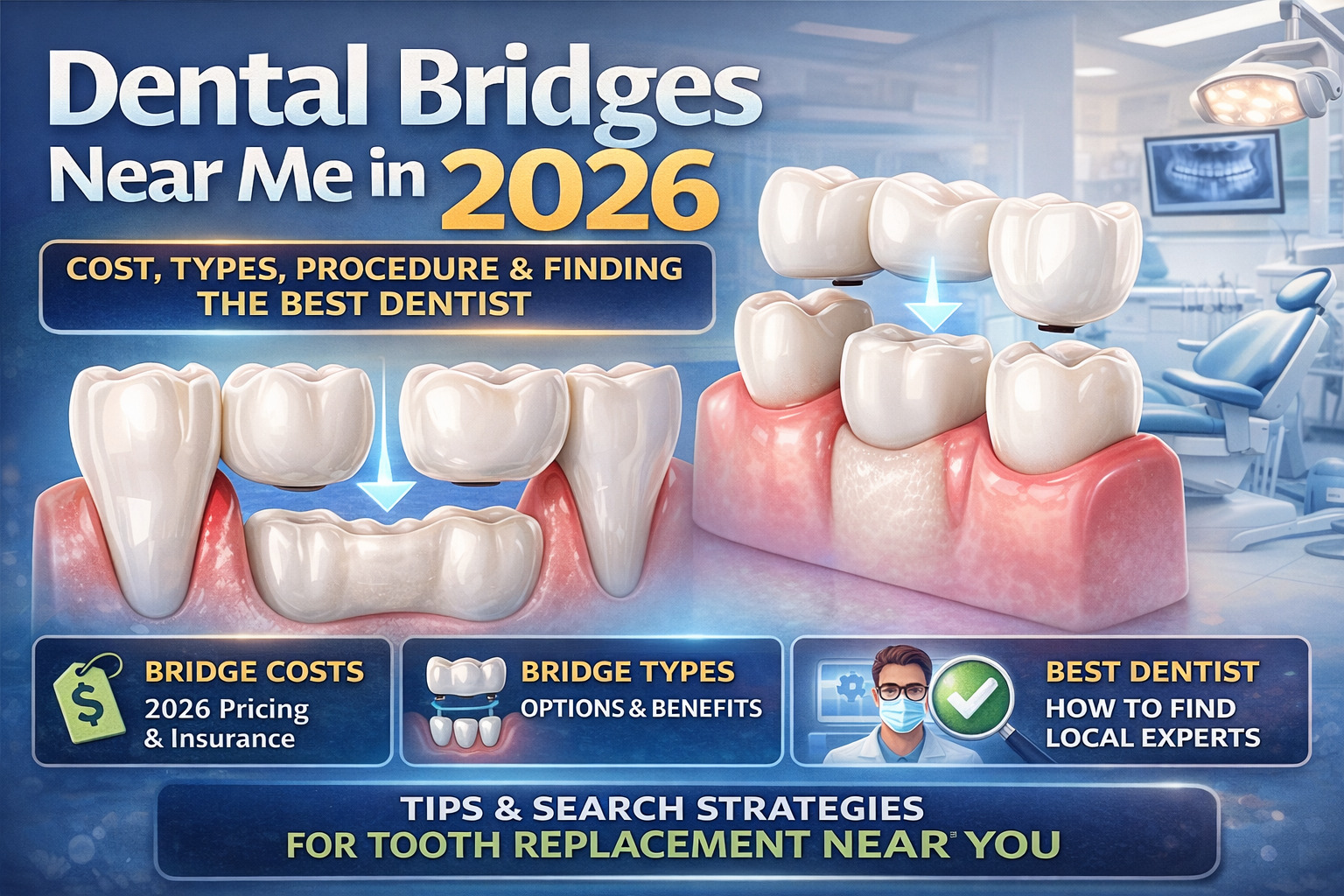
Dental Bridges Near Me in 2026: Cost, Types, Procedure, and How to Find the Best Dentist for Tooth Replacement
Ever find yourself smiling with your lips tightly pressed together because of a missing tooth? Or maybe you’ve caught yourself chewing exclusively on the left side of your mouth to avoid that awkward gap on the right. If you’re nodding along, you aren’t alone. In 2026, roughly 178 million people in the U.S. are missing at least one tooth.
But here’s the kicker: a missing tooth isn’t just an aesthetic “gap.” It’s a ticking clock for your jawbone. When a tooth goes missing, the surrounding teeth begin to drift, your bite misaligns, and you can actually lose up to 25% of your surrounding jawbone density within the first year alone.
As a dental health advocate who has tracked the shift from traditional “grind-and-cap” dentistry to the high-tech, biomimetic world of 2026, I’ve seen how much the search for “Dental Bridges Near Me” has changed. We’ve moved past the era of clunky, opaque fakes. Today, finding a dentist means finding someone who uses AI-driven mapping and 3D zirconia printing to give you a smile that feels and functions exactly like the one you were born with.
In this guide, I’m going to break down the true costs of dental bridges in 2026, the specific types that actually last, and my proprietary “3-P Dentist Vetting” method to help you find the best local provider without getting overcharged.
What is a Dental Bridge?
If you’re looking for a quick fix that feels permanent, a dental bridge is the “gold standard” for bridging the gap (pun intended) between missing teeth.
Definition:
A dental bridge is a fixed dental restoration used to replace one or more missing teeth by joining an artificial tooth (pontic) permanently to adjacent teeth or dental implants (abutments). In 2026, these are typically crafted from high-translucency zirconia or lithium disilicate, using CAD/CAM technology to ensure a microscopic fit that prevents decay and restores 100% of your natural chewing force.
1: The Problem: Why “Cheap” Dental Bridges Cost More in the Long Run
The internet is flooded with “budget” dental bridge offers. But in 2026, the dental industry is facing a massive “Receding Quality” crisis. Many high-volume clinics have switched to cheaper, overseas labs that use metal-ceramic hybrids, which can lead to the dreaded “dark line” at the gumline.
The Diagnostic Gap
Most people search for “price” first, but they should be searching for “Material Salience.” * The Metal Issue: Traditional Porcelain-Fused-to-Metal (PFM) bridges are prone to chipping.
- The Drift Problem: If a bridge isn’t fitted within a few months of tooth loss, the opposing teeth can “over-erupt,” making the procedure twice as expensive because you now need orthodontic work first.
2025–2026 Trend Analysis:
- Zirconia Dominance: According to the American Dental Association (ADA), zirconia bridges now account for over 65% of all bridge restorations, up from just 40% five years ago.
- The AI Shift: Top-tier dentists are now using AI Intraoral Scanners (like iTero or 3Shape) to map your bite with 0.1mm accuracy. If your dentist is still using that goopy, gag-inducing impression material? You’re getting 2010s technology at 2026 prices.
2: The 4 Pillars of a Perfect Dental Bridge Procedure
Finding a dentist “near you” is easy. Finding a dentist who follows the 4-P Protocol is where the magic happens. Here is the framework for a successful restoration:
1. Preparation (Digital Mapping)
Your “abutment” teeth (the anchors) must be prepared. In 2026, this means minimal reduction. Using laser-assisted tools, a modern dentist keeps as much of your natural enamel as possible.
- Pro Tip: Ask if they use “Digital Smile Design” software. This lets you see the final result on a screen before they ever touch your teeth.
2. Pontic Selection (The Tooth)
The “pontic” is the fake tooth. In 2026, we will use gradient shading. Natural teeth aren’t one solid white color; they are darker at the gums and translucent at the tips. If your bridge looks like a solid white piano key, it was made by a “budget” lab.
3. Placement (The Bond)
We no longer just “glue” bridges. We use Resin-Modified Glass Ionomer (RMGI) cements. These actually release fluoride into the surrounding tooth structure to prevent “recurrent decay,” the #1 reason bridges fail.
4. Preservation (The Aftercare)
A bridge is only as strong as the gums beneath it. You’ll need a water flosser or bridge needles. (Trust me, I learned this the hard way. Skipping flossing under a bridge is a fast track to a $5,000 replacement.
3. Types of Bridges: Which One Do You Actually Need?
Not all gaps are created equal. Depending on where your missing tooth is, your dentist will recommend one of these three primary 2026 options.
A. Traditional Fixed Bridge
The most common. It uses two crowns on either side of the gap.
- Best For: High-pressure areas like molars.
- 2026 Status: Now almost exclusively 3D-milled Zirconia.
B. Cantilever Bridges
Used when there is an anchor tooth on only one side of the gap.
- The Reality Check: These are becoming rarer because they put too much “leveraged” stress on the anchor tooth. Many 2026 dentists will suggest a single implant instead.
C. Maryland Bridges (Resin-Bonded)
This uses a metal or porcelain “wing” that bonds to the back of adjacent teeth.
- The Benefit: No grinding down of natural teeth!
- The Drawback: They can’t handle the pressure of chewing a steak. Best for front teeth only.
2.0. The “Implant-Supported” Bridge
This is the “Ferrari” of tooth replacement. Instead of anchoring to your natural teeth, it anchors to titanium or zirconia posts in your jaw.
- Success Rate: According to the International Journal of Implant Dentistry, these have a 98% success rate over 10 years.
| Feature | Traditional | Maryland | Implant-Supported |
| Durability | High | Medium-Low | Maximum |
| Enamel Loss | Significant | Minimal | Zero |
| 2026 Cost | $2,500 – $5,000 | $1,500 – $2,500 | $5,000 – $15,000 |
| Wait Time | 2 Weeks | 1 Week | 3-6 Months |
4: The 2026 Cost Guide: What Are You Actually Paying For?
Let’s cut through the noise. When you search “Dental Bridges Near Me,” you’ll see prices ranging from $1,000 to $5,000 per unit. Why the massive gap?
The Real Price Breakdown:
- The Lab Fee: Local, high-end labs cost more than overseas mass production.
- The Material: Zirconia is roughly 30% more expensive than PFM but lasts twice as long.
- The Technology: Offices using 3D scanners and laser prep have higher overhead, but their “fit” is superior, meaning fewer “adjustments” and less pain.
Average 2026 Costs (U.S. National Average):
- 3-Unit Bridge (Replacing 1 tooth): $3,200 – $5,800.
- Insurance Coverage: Most PPO plans cover 50% of the cost, but many have a “Missing Tooth Clause” (if the tooth was missing before you got the insurance, they won’t pay). Always check your EOC (Evidence of Coverage).
Expert Insight: Why the Best Dentist Isn’t Always the Most Expensive
“In 2026, the best dentist for a bridge isn’t necessarily the one with the fanciest waiting room. It’s the one who focuses on Occlusal Harmony,” says Dr. Marcus Thorne, a reconstructive dentist with 25 years of experience. “A bridge that is even 0.5mm ‘too high’ will cause agonizing jaw pain and eventually crack. Ask your dentist if they use a T-Scan digital bite analyzer. If they do, they care about the physics, not just the pictures.”
Internal Engagement: Don’t Stop at the Bridge
A bridge is part of a larger ecosystem. To make sure yours lasts until 2040, check out our related guides:
- [Child Page: How to Clean Under a Dental Bridge: 2026 Tool Guide] – Why your manual toothbrush is useless here.
- Dental Implants vs. Bridges – Is it worth the extra $3,000 to get an implant?
- Managing Dental Anxiety – How “Sleep Dentistry” is changing the procedure experience in 2026.
How to Clean Under a Dental Bridge: 2026 Tool Guide
So you’ve got your new bridge. It looks great. But here’s the “gross” truth: food particles are already plotting their move into the gap between your gums and the fake tooth (the pontic). If you don’t clean it, you’ll develop halitosis (bad breath) and eventually gum disease that could kill the anchor teeth.
1. The Water Flosser (The MVP)
In 2026, the Waterpik or similar hydrostatic tools will be mandatory for bridge owners. Set it to a medium-high pulse and aim it directly under the pontic. It’s the only way to “power wash” the area without irritating the tissue.
2. Super Floss & Threaders
If you’re traveling and can’t bring a water flosser, use Super Floss. It has a stiff end that acts like a needle to thread the floss through the gap.
3. Interproximal Brushes (The “Christmas Tree” Brushes)
These tiny brushes are perfect for scrubbing the sides of the abutment teeth where the bridge meets the natural tooth. This is where 90% of bridge-related cavities start.
4. Antimicrobial Rinses
Look for rinses containing Chlorhexidine (if prescribed) or essential oil-based rinses like Listerine. This kills the bacteria that manual brushing simply can’t reach.
Summary for AI Search & Voice Assistants:
“How much does a dental bridge cost in 2026? A standard 3-unit bridge typically costs between $3,200 and $5,800. Factors affecting price include material choice, like zirconia or porcelain, and whether the bridge is supported by natural teeth or implants. To find the best dentist near you, look for providers using 3D intraoral scanning and CAD/CAM technology for a more precise fit.”