Eye Drops Recall 2026: FDA Warns Consumers After KC Pharmaceuticals Eye Drops Recalled Over Safety Concerns
Health · Safety · Consumer Alerts · Updated April 4, 2026
⚠ BREAKING FDA Enforcement Report D-0409-2026 through D-0416-2026 · Event ID 98533 · Recall ongoing – no termination date set FDA Recall Alert · Eye Care Safety
Over 3.1 million bottles. Eight product types. Sold at CVS, Walgreens, Kroger, and dozens more retailers. Here’s everything you need to know right now, including what the “lack of assurance of sterility” warning actually means for your eyes.
⛔ Immediate Action Required
If you purchased eye drops at Walgreens, CVS, Kroger, Rite Aid, H-E-B, Publix, Meijer, Harris Teeter, or Dollar General recently, check your bottle’s brand name and lot code against the list below. If there’s a match,h stop using the product immediately.
What is the Eye Drops Recall of 2026?
The Eye Drops Recall of 2026 refers to a voluntary nationwide recall of 3,111,072 bottles of over-the-counter eye drop products manufactured by K.C. Pharmaceuticals, Inc. of Pomona, California. The recall, initiated on March 3, 2026, and classified by the FDA as a Class II recall on March 31, 2026, was triggered by a “lack of assurance of sterility,” meaning the manufacturer could not guarantee the products were free from contamination by bacteria, fungi, or other harmful microorganisms. Eight product types were affected, sold under various store-brand names at major U.S. retailers.
3.1M+Bottles Recalled
8Product Types Affected
Mar 3Recall Initiated
Class IIFDA Classification
You’ve probably glanced at the bottle a hundred times. “Sterile Eye Drops.” “Artificial Tears.” “Dry Eye Relief.” These are the kind of products that live in bathroom medicine cabinets across America, picked up without a second thought from a drugstore shelf for under five dollars. But as of April 2026, more than 3 million of those bottles may be anything but sterile.
K.C. Pharmaceuticals, Inc., a Pomona, California-based company that quietly bills itself as the largest private label eye care supplier in North America, servicing 26 of the top 30 U.S. retailers and more than 90,000 stores, initiated one of the largest OTC eye drop recalls in recent memory. And the reason is deeply uncomfortable: they can’t guarantee those “sterile” bottles are actually sterile.
Here’s why that matters. A lot.
Why a “Lack of Assurance of Sterility” Is More Serious Than It Sounds
When the FDA uses the phrase “lack of assurance of sterility,” it can feel like bureaucratic hedging. It’s not. It means the manufacturer cannot confirm that their production or packaging process reliably prevented contamination,n and that’s a foundational failure for a product you’re putting directly into your eyes.
Your eyes are one of the most vulnerable surfaces on your body. Unlike skin, they have almost no barrier against infection. Introduce contaminated fluid directly onto the cornea, and you’ve created a direct pathway for bacteria, fungi, or viruses to cause what ophthalmologists call sight-threatening infections.
“Whenever we talk about using eye drops for the ocular system, it’s really important that there’s no bacterial contamination because that can cause significant and sight-threatening infections.”- Dr. Nicole Bajic, Ophthalmologist, Cleveland Clinic
Beyond the pain and irritation that come with an eye infection, contaminated eye drops can cause symptoms ranging from yellow or green discharge and blurred vision to, in worst-case scenarios, permanent vision loss. This isn’t hypothetical scaremongering.
The 2023 Precedent That Should Make Everyone Pay Attention
In 2023, 81 people developed rare, antibiotic-resistant infections with Pseudomonas aeruginosa after using contaminated eye drops. Four of those people died. Four had to have an eye surgically removed. The culprit was EzriCare Artificial Tears, also an OTC product that seemed completely routine. That outbreak reshaped how the FDA and consumers now approach eye drop safety, and it’s exactly why the current KC Pharmaceuticals recall is being taken seriously.
📋 What “Class II Recall” Actually Means
The FDA classifies recalls into three levels. Class I is the most severe productlikely to cause serious health harm or death. Class II, the designation assigned here, covers situations where use “may cause temporary or medically reversible adverse health consequences, or where the probability of serious adverse health consequences is remote.” Class III is the least severe. Class II doesn’t mean “probably fine.” It means the risk of serious harm is considered remote n,ot zero. Learn more about FDA recall classifications.
Importantly, the FDA has not confirmed that any of the recalled bottles were actually found to be contaminated. What it confirmed is that the safety standards required to ensure sterility were not met. That’s still a recall-worthy problem because you simply cannot tell by looking at a bottle whether it’s harboring something dangerous.
This is worth sitting with for a second. The product looks the same. It smells the same. There’s no visible sign that anything is wrong. But the manufacturer can’t assure you it went through a process rigorous enough to guarantee sterility. That’s why the recall happened at all.
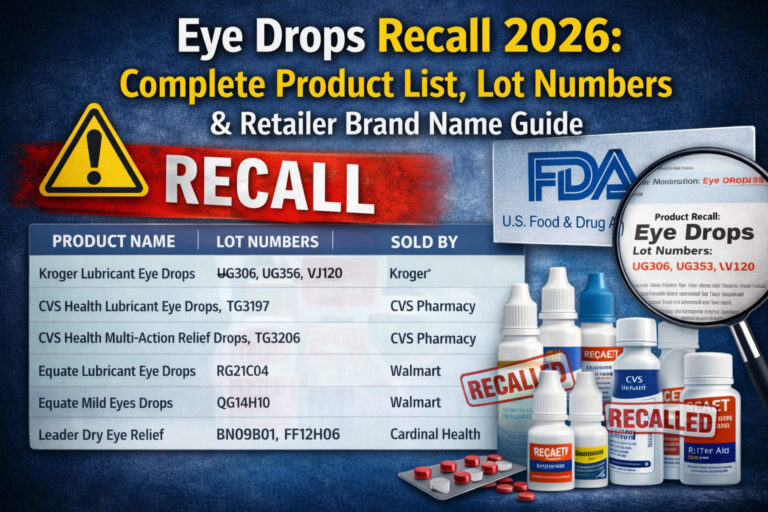
📌 Related: Complete Product List & Lot Codes — Eye Drops Recall 2026 (Child Page) Full table of all 8 recalled products with NDC numbers, lot codes, expiration dates, and retailer-specific brand names.
The Complete List of Recalled Eye Drop Products
KC Pharmaceuticals operates as a private label manufacturer; it makes the product, and retailers slap their own brand name on the bottle. That’s why the same recalled formula might be called “Walgreens Dry Eye Relief” in one store and “Kroger Lubricant Eye Drops” in another. Eight distinct product formulas are involved, covering over 3.1 million individual units distributed across the U.S.
| Product Name | Active Ingredient(s) | Units Recalled | Status |
|---|---|---|---|
| Sterile Eye Drops AC | Tetrahydrozoline HCl 0.05%, Zinc Sulfate 0.25% | 182,424 | Recalled |
| Eye Drops Advanced Relief | Dextran 70 0.1%, PEG 400 1%, Tetrahydrozoline HCl 0.05% | 303,216 | Recalled |
| Dry Eye Relief Eye Drops | Glycerin 0.2%, Hypromellose 0.2%, PEG 400 1% | 1,023,096 | Recalled |
| Ultra Lubricating Eye Drops | Polyethylene Glycol 400 0.4%, Propylene Glycol 0.3% | ~varies | Recalled |
| Sterile Eye Drops Original Formula | Tetrahydrozoline HCl 0.05% | ~varies | Recalled |
| Sterile Eye Drops Redness Lubricant | Glycerin 0.25%, Naphazoline HCl 0.012% | ~varies | Recalled |
| Sterile Eye Drops Soothing Tears | PEG 400 0.4%, Propylene Glycol 0.3% | ~varies | Recalled |
| Artificial Tears Sterile Lubricant Eye Drops | Polyvinyl Alcohol 0.5%, Povidone 0.6% | ~varies | Recalled |
All recalled bottles are 0.5 fl oz (15 mL). Affected expiration dates range from April 30 to July 31, 2026 (some lots extend to October 2026). The recall numbers span D-0409-2026 through D-0416-2026, all under FDA Event ID 98533.
⚠️ How to Check Your Bottle: Lot Code Prefixes to Watch For
The recalled lots begin with these prefixes. If your bottle’s lot code starts with any of these letters AND has a 2026 expiration date, it may be part of the recall:
ACARLTSURGRLSYAT
For exact lot codes and NDC numbers, consult the official FDA recall database.
Which Retailers Sold the Recalled Eye Drops?
Because KC Pharmaceuticals is a private label supplier to dozens of major chains, the recalled product shows up under many different store-brand names. Here’s where these bottles were distributed:
💊 Walgreens
💊 CVS Health
💊 Rite Aid
🛒 Kroger
🛒 H-E-B
🛒 Publix
🛒 Meijer
🛒 Harris Teeter
🏪 Dollar General
⛽ Circle K
🏥 Cardinal Health
🏥 McKesson
🎖 Military Exchanges
💊 Good Neighbor Pharmacy
💊 Discount Drug Mart
Some recalled products also carry the store-brand names Best Choice, Equaline, Leader, Gericare, and Cintas. The reach of this recall is wide, de specifically because KC Pharmaceuticals supplies so many private-label programs simultaneously.
📌 Related: Check the full retailer-specific brand name table → See exactly which product name to look for at each store.
What You Should Do Right Now: A Step-by-Step Guide
Here’s the kicker — a lot of people read recall headlines and do nothing, either because they assume the risk is low, or because they’re not sure the product they have is even affected. Don’t be that person. This takes two minutes.
- 1 Go check your medicine cabinet right now. Pull out any eye drop bottles you have. Look at the brand name and the product name on the label. Cross-reference it against the eight recalled product names above.
- 2 Check the lot code and expiration date. Flip the bottle to find the lot number (typically printed near the expiration date). If the lot code prefix matches AC, AR, LT, SU, RG, RL, SY, or AT, and the expiration is in 2026, set the bottle aside. For exact lot-code verification, visit the FDA’s official recall database.
- 3 Stop using it. Don’t give it to someone else. Even if you’ve been using it without any immediate problems, stop. You can’t see contamination with the naked eye. Passing it along to a friend or family member is also a no-go.
- 4 Return the product to the store for a refund. Major retailers have confirmed they’re accepting returns. CVS confirmed to ABC News that affected products may be returned to any CVS Pharmacy for a refund. The same policy generally applies at Walgreens, Kroger, and others. You don’t typically need a receipt for safety recalls; the store should honor the return regardless.
- 5 Monitor your eyes. See a doctor if anything feels off. If you’ve already been using the recalled drops, watch for any unusual symptoms (see the list below). Don’t wait to see if it gets better on its own. Eye infections move fast.
- 6 Report adverse effects to the FD A. If you experienced any health issues you believe are related to these products, report them through the FDA MedWatch. Your report helps regulators track the real-world impact of recalls like this one.
✅ Good News: As of April 2026, No Injuries Reported
The FDA and KC Pharmaceuticals have confirmed there are no reports of injuries or adverse health effects linked to the recalled products. That doesn’t mean there’s no risk going forward; it means you have an opportunity to act before anyone gets hurt. The recall is precautionary but meaningful.
What Symptoms Should I Watch For?
If you’ve used any of the recalled eye drops and notice these symptoms, see an eye doctor or visit urgent care promptly:
🔴 Increased redness or irritation
💧 Yellow or green discharge
🌫️ Blurred or worsening vision
🔥 Eye pain or a burning sensation
💡 Sensitivity to light
😣 Feeling of something in the eye
These symptoms can indicate a bacterial or fungal eye infection, both of which are medical emergencies when left untreated. The good news is that if caught early, most eye infections respond well to treatment. The danger is waiting.
Why Eye Drop Sterility Failures Keep Happening And What the FDA Requires
This isn’t the first time, and if history is any guide, it won’t be the last. In 2025, pharmaceutical manufacturer AvKare recalled over 75,000 cases of eye drops after an FDA audit found manufacturing deviations. In 2023, the EzriCare outbreak killed four people. There’s a pattern here, and understanding it helps you make smarter decisions as a consumer going forward.
What the FDA Actually Requires for Sterile Eye Drops
The FDA mandates a rigorous, multi-stage process for products that must be sterile. Manufacturers are required to produce in a controlled, sterile environment; run sterilization processes to eliminate potential microorganisms; conduct microbial testing on finished product; hold product in quarantine while test results are confirmed; and use packaging that maintains sterility through to the consumer.
If anything breaks down in that chain, a contamination event in the facility, defective bottle seals, a failed sterilization cycle, or inadequate testing, the manufacturer can no longer assure the product is sterile and is legally obligated to issue a recall. What’s unclear in the KC Pharmaceuticals case is exactly where in that chain the breakdown occurred. The company has not issued a public statement explaining the root cause.
Sterility issues are more common in over-the-counter eye drops than in prescription products, but thanks to strict FDA regulations, it remains extremely rare for any eye product to be recalled on this scale.Based on FDA consumer safety reporting guidelines, 2026
Why Private Label Products Are Especially Vulnerable
Here’s something most articles about this recall miss. KC Pharmaceuticals isn’t just one manufacturer,r it’s a supplier to more than 90,000 stores under dozens of different brand names. When a private label manufacturer has a sterility problem, it multiplies. A single production batch doesn’t just end up in one store under one brand name; it ends up across the entire retailer network, under dozens of different labels, looking like completely different products.
That’s why the reach of this recall is so staggering. One company, one quality control failure, eight product names, fifteen-plus retailer chains, 3.1 million bottles. The private label business model is efficient and cost-effective, but when something goes wrong, the exposure is enormous.
💡 Consumer Safety Tip: What to Look For in Safe Eye Drops
Eye Drop Safety, a consumer safety organization, advises against using products marketed as “natural” or “homeopathic” eye drops, as the FDA does not regulate them the same way it does conventional artificial tears,s meaning their sterility and ingredient safety may not be guaranteed. Stick to FDA-regulated, clearly labeled OTC products from established manufacturers, and check the FDA’s current recall database periodically if you use eye drops regularly.
A Brief History of Major Eye Drop Recalls: Why This Keeps Happening
The 2026 KC Pharmaceuticals recall doesn’t exist in a vacuum. It’s part of a pattern of eye care product safety failures that has drawn increasing scrutiny from both the FDA and consumer advocacy groups over the past three years.
2023 EzriCare Artificial Tears: The most severe eye drop safety failure in recent U.S. history. Contaminated with Pseudomonas aeruginosa, a particularly dangerous, drug-resistantbacteriuma, the product sickened 81 people across 18 states. Four died. Four lost an eye. The FDA issued a Class I (most severe) recall. This case fundamentally changed how the FDA approaches OTC eye drop inspections.
2025 AvKare Eye Drops: Following an FDA manufacturing audit that identified production deviations, AvKare recalled more than 75,000 cases of eye drops. No injuries were reported, but the recall highlighted continued quality control challenges in the industry.
2026 KC Pharmaceuticals: The largest in units over 3.1 million bottles, with the broadest retail distribution of any recent recall. Classified as Class II; no confirmed contamination found; no injuries reported as of publication.
The research is actually mixed on what’s driving the frequency of these events. Some experts point to supply chain pressurespost-pandemicm, i c pushing manufacturers to cut corners. Others argue that the FDA’s increased inspection frequency after 2023 is simply catching more issues that existed before. Both things canbe truee simultaneously, and neither is particularly comforting if you’ve been using these drops every day for dry eyes.
Frequently Asked Questions: Eye Drops Recall 2026
Can I keep using the recalled eye drops if I don’t have symptoms?
Technically, for a Class II recall, the FDA says people can continue using a product unless the company specifically instructs otherwise. However, the general medical consensus is that you should stop using any recalled ophthalmic product and return it. Eye infections can develop without warning, and there’s no way to visually confirm whether your bottle is contaminated. The FDA advises returning or disposing of affected products.
How is KC Pharmaceuticals related to the brands I see at Walgreens or CVS?
KC Pharmaceuticals is a private labmanufactureractItit produces the actual product, but sells it to retailers who then put their own store-brand labels on it. So “Walgreens Lubricant Eye Drops” and “Kroger Dry Eye Relief” may be the exact same product from the same production line, just in differently labeled bottles. This is standard practice in the OTC pharmaceutical industry and is why one manufacturer’s recall can span so many apparently different products.
Were any of the recalled bottles actually found to be contaminated?
No. The FDA report states that the recall is due to a “lack of assurance of sterility,” meaning the manufacturer couldn’t guarantee its quality control process was sufficient to prevent contamination. It does not mean contamination was confirmed in any specific lot. However, that uncertainty itself is the safety concern.
What’s the difference between a Class I and Class II recall?
Class I recalls involve products with a reasonable probability of causing serious health harm or death. Class II recalls the classification applied here involves products that may cause temporary or medically reversible adverse health consequences, where the probability of serious harm is remote. Class III is the least severe. None of these classifications means the product is safe to continue using; they reflect the FDA’s assessment of risk severity.
How do I know if my specific bottle is part of the recall?
Check the lot code on your bottle against the codes listed in the FDA enforcement report. Affected lot codes typically start with AC, AR, LT, SU, RG, RL, SY, or AT, with 2026 expiration dates. The most reliable way to verify is to check the FDA’s official enforcement database at fda.gov using the recall numbers D-0409-2026 through D-0416-2026.
Where can I get a refund for recalled eye drops?
Return the product to the store where you purchased it. CVS, Walgreens, Kroger, and other major retailers have confirmed they will accept returns of recalled products for refunds. You typically do not need the original receipt for a safety recall return. If you have difficulty, contact the retailer’s customer service or the FDA’s consumer complaint line.
Are prescription eye drops affected by this recall?
No. This recall involves only over-the-counter (OTC) eye drop products manufactured by KC Pharmaceuticals under various private label brand names. Prescription eye drops are not affected by this recall, though they have separate safety monitoring requirements and have been involved in other recalls unrelated to this one.
What are safe alternatives to the recalled eye drops?
For dry eye relief, lubricating eye drops like Refresh, Systane, or Blink brand products from established manufacturers are widely available and not part of this recall. Always check the FDA recall database before purchasing any new OTC eye drop product, and consult your eye doctor or pharmacist for personalized recommendations, especially if you have chronic dry eye disease, contact lenses, or other eye conditions.
Official Sources and Further Reading
This article is based on official government and verified news sources. For the most current information on the recall status, always refer directly to the FDA’s official communications:
- → FDA Official RecallDatabase Searchh recall numbers D-0409-2026 through D-0416-2026 or Event ID 98533 for the complete KC Pharmaceuticals recall file, including all affected lot numbers and NDC codes.
- → FDA Drug RecallPage: The A’s central hub for all current drug and pharmaceutical product recalls in the U.S., updated continuously.
- → FDA MedWatch — Report an Adverse Event. If you’ve experienced health problems you believe may be related to a recalled product, report it through MedWatch. Your report contributes to FDA safety monitoring data.
- → CDC Eye Health and Hygiene Guidelines: The Centers for Disease Control and Prevention’s guidance on safe eye care practices, including proper use of eye drops and preventing eye infections.
📌 : Eye Drops Recall 2026: Full Product List, Lot Numbers & Retailer Guide – A comprehensive reference page with all NDC numbers, exact lot codes, retailer-specific brand names, and a step-by-step self-check tool.
This article was last updated on April 4, 2026. As this is an ongoing recall, new information may emerge. Always refer to the FDA’s official recall page for the most current status. This content is informational only and does not constitute medical advice. If you have health concerns, consult a qualified healthcare provider.
© 2026 skillshowcase. This article is for informational purposes only and does not constitute medical or legal advice.