Jehovah’s Witnesses Ease Blood Transfusion Policy: Allow Use of Stored Personal Blood – What It Means, What It Doesn’t, and Why It Matters
One of the biggest religious medical-policy shifts in decades took place on a Friday in late March 2026, and no one seemed to notice. The Governing Body of Jehovah’s Witnesses, the 9-member leadership council based in Warwick, N, has issued what it terms a “clarification” of its long-established teaching on blood transfusions. Now, for the first time in its history, members can opt to have their blood taken and stored in advance, and infused back into their bodies during planned surgical procedures.
That might sound like a minor procedural footnote. It isn’t.
For decades, this practice, known as autologous blood storage, or preoperative autologous donation (PAD), has been explicitly prohibited. The Watchtower, the body publishing of the organization’s own official document, claimed as late as 2000: “so we do not donate blood, nor do we store for transfusion our blood.” That same directive said that the conduct was a violation of God’s law.
Now? It’s a personal conscience issue.
I will explain to you exactly what changed and what didn’t, why this decision is being met with cautious relief and raging criticism, what autologous blood transfusion means medically, and why doctors and ethicists from around the world are holding their breath. Because underneath the religious-speak is a really complex question about faith and medicine and what autonomy actually means when we’re talking about children who never had a choice.
What Jehovah’s Witnesses Believe About Blood And Why It’s Been Controversial for Decades
To understand the weight of this change, you need to understand where the original prohibition came from.
Jehovah’s Witnesses derive their refusal of blood transfusions from biblical admonitions to “abstain from blood,” an application of principle that they believe goes much further than dietary law and includes medical treatments that involve the use of blood. This interpretation,n based on texts from the Old and New Testament, has not only been a defining but a terribly divisive point of the religion for over 60 years.
It is here that it becomes complex. The organization has never enforced this ban uniformly. Through the years, the Governing Body has dissected its own teachings with meticulousness, almost surgical precision, if you’ll excuse the pun.
Procedures in which blood is temporarily diverted out of the body but returned almost continuously, such as kidney dialysis, for instance, or heart-bypass surgery, have long been considered acceptable. Why? Because it’s not circulating, it’s never fully “taken out.” But storing blood outside the body for later reinfusion? That was categorically different. The rationale: After blood is removed from the body and stored, it must be “poured out,” in accordance with the biblical directive followed by ancient Israelites. The teaching was that to re-inject stored blood violated the sanctity of blood as a sacred principle.
And millions of Jehovah’s Witnesses lived and died under that interpretation.
The 1994 May 22 issue of Awake! The magazine had pictures of 26 children under the heading “Youths Who Put God First,” who had died clinging to the prohibition against blood. That image has haunted opponents of the measure for 30 years.
An AJWRB medical adviser estimated that the blood ban has caused the death of some 33,246 Jehovah’s Witnesses since 1961, which translates to approximately 594 deaths per year. Journalist Lee Elder, accounting for the AJWRB figures, observed that this number is larger than the entire death count in the Jonestown massacre, yet it very rarely gets the same type of attention. Just to be clear: these are disputed numbers, and because most deaths are logged under their proximal medical cause (hemorrhage, severe anemia), and not the distal cause of transfusion refusal, the real number may never be known.
The organization itself fiercely disputes that characterization. On jw.org, the official website of the Jehovah’s Witnesses, it portrays bloodless medicine as a medical frontier rather than a risky pseudoscience, citing several techniques pioneered by physicians who treated Jehovah’s Witness patients that have become common surgical practice throughout the world.
Both things can be true at once.
The March 2026 Announcement: Exactly What Changed
On Friday, 20 March 2026, Gerrit Lösc,h a member of the Governing Board,dy stated that “every Christian has to decide for himself how he wants to use his own blood for any medical and surgical treatment”. He was presenting the change as a refinement, not a reversal of policy. THE BODY said in a press release at the time that “our fundamental belief in the sanctity of blood remains unchanged.”
Let’s be specific about what this actually permits.
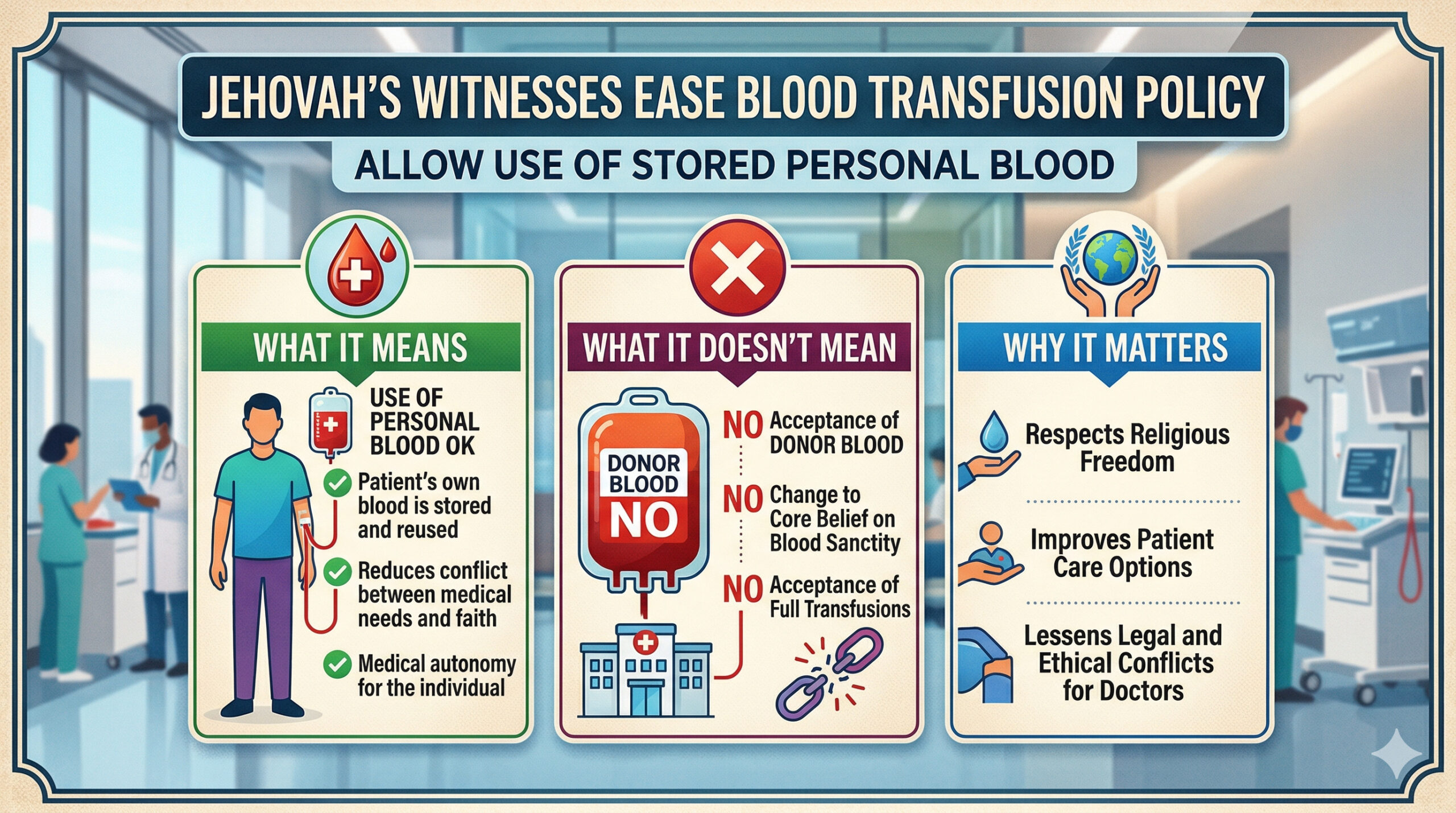
What’s now allowed personal discretion:
- Getting your own blood drawn and stored weeks before a planned surgery
- If you bleed, that stored blood can be reinfused during or after the surgery
- This is technically known as preoperative autologous donation (PAD) or autologous blood transfusion
Lösch spoke about the growing complexity of contemporary medical treatments and made it clear, “The Bible is silent on the application of a person’s own blood in medical and surgical treatment,” the very same logic dissenters had for years been pressing the body to embrace.
What remains forbidden is no personal discretion:
- Getting blood from another person (allogeneic transfusion)
- Blood products from a distant donor for use in an emergency
- The basic ban that shaped the religion’s medical approach since the 1940s.
A spokesperson affirmed: “Our fundamental conviction about the sanctity of blood has not changed,” depicting the update as a revision in procedure rather than a change in doctrine.
Here’s the bottom line, and this is the part most headlines overlooked:
This is good news only if you know you have to have surgery. Just walk into a hospital after a car wreck, bleed you buckets, and the old rules still apply. The prohibition against blood donors in emergency situations, in particular, life-threatening emergencies for children, remains absolute.
How Autologous Blood Transfusion Works Medically
Before you can evaluate whether this policy change actually saves lives, you need to understand the procedure it now permits.
Autologous blood transfusion is a medical procedure in which a patient receives their own blood during surgery to replace blood lost during the operation. It sounds simple. The actual process has several layers.
The Three Methods of Autologous Transfusion
1. Preoperative Autologous Donation (PAD)
Here’s what the new policy allows among Jehovah’s Witnesses. As stated in a study found on PubMed (NCBI), autologous transfusion may include preoperative collection of blood, its storage,e and reinfusion intraoperatively, with either immediate preoperative phlebotomy with subsequent hemodilution, or intraoperative blood salvage.
Now here’s a practical example of how that works: Weeks before a scheduled surgery, usually 4 to 6 weeks away, the patient gives one or more units of their own blood. The blood is then stored in a blood bank and marked solely for that person’s use. On the day of surgery, as soon as substantial bleeding develops, the stored blood of the patient is transfused.
At places such as UR Medicine, all autologous donations must be done no less than three days before surgery, with a minimum of three days apart for each donation. Once the patient is discharged, any unused blood is discarded.
2. Acute Normovolemic Hemodilution (ANH)
In this technique, blood is withdrawn immediately before surgery begins and replaced with saline or other fluids. The diluted blood that remains in the patient’s system loses proportionally fewer red blood cells during surgical blood loss. The stored pre-surgery blood is then returned toward the end of the procedure.
3. Intraoperative Cell Salvage (ICS)
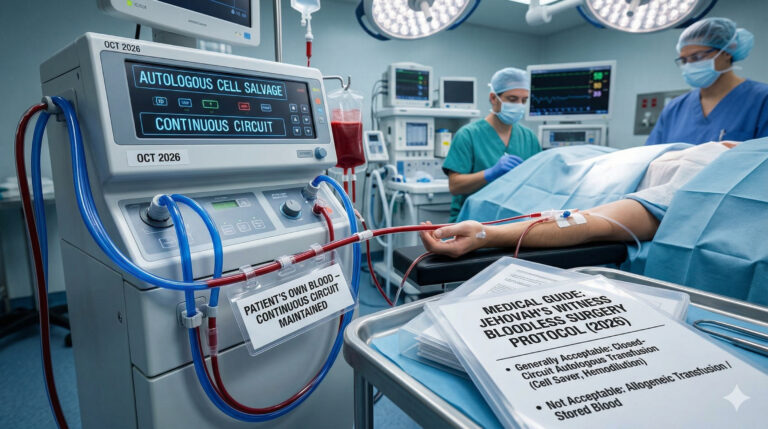
Also known as “cell saver” technology, this method recovers blood lost during surgery, processes it, and returns it to the patient in real time. Jehovah’s Witness members · Some individual Jehovah’s Witnesses have also long accepted this form of autotransfusion, albeit with a modified circuit that ensures continuous contact with the body. The main difference: the blood is never really ”stored” outside the body in a different container.
Why Does This Matter Medically?
PMC free article published in the National Institutes of Health reports that preoperative autologous blood donation can promote bone marrow cell proliferation, induce red blood cell regeneration, and enhance hematopoietic function – ie, not only during surgery does the patient’s blood system work better, but after surgery as well.
The safety profile is robust. A review in the British Journal of Anaesthesia Education states that autologous transfusion preserves resources and decreases the associated risk of viral and prion transmission, with cell salvage being the safest and the most versatile technique.
But those are real dangers, and they shouldn’t be downplayed. A risk of preoperative autologous blood donation is transfusion of a unit to the wrong person, and there is the possibility of reinfusing cancer cells, platelets, and other clotting factors when using the salvage technique during surgery. That’s something that has to be very carefully evaluated by a doctor, particularly for cancer patients.
But that doesn’t obviate the basic problem that critics have pointed out: you need time. You have to have a scheduled surgery. You need a blood bank that can store and track your units. These are the conditions that are often lacking in the countryside, in a poor country, or in a simple emergency.
What Didn’t Change And Why Critics Say That’s the Real Problem
Now, we just need to be clear about the limitations here because there are a couple of huge commentators who believe we’ve gotten too excited about this change in policy.
Skeptics argue that the storage of autologous blood is a process that must be planned out ahead of time and is feasible only for elective surgeries. The prohibition of the use of donor blood in emergencies, even for pediatric patients, continues in full force.
It’s that last bit for children where this discussion becomes truly heartbreaking.
It is a rare sort of case in which the parents of a critically ill child refuse to allow a blood transfusion for their own reasons, but such cases have gone before courts around the world. Courts in the U.K., Australia, Canada, and the U.S. have routinely overturned parental refusal to allow life-saving blood transfusions for minors. In several countries, the judiciary has intervened to prevent religiously motivated parental decisions from resulting in the death of a child.
There is just no way a child can do that on their own. They are not able to consent. They are not able to “choose their own conscience” on an issue that their parents’ faith has already decided they must hold. And the policy change doesn’t alter that reality one bit.
Critics and ex-members commenting after the announcement questioned why the ban on transfusions wasn’t lifted altogether in line with the reasoning Lösch cited for the autologous change – that “the Bible is silent” on the issue.
That’s a good question. If “the Bible makes no comment” on the issue of storing and then reinfusing one’s own blood, then the Governing Body’s turnaround from “forbidden” to “personal conscience” would be understandable. But by that same reasoning, the Bible is equally silent about the particulars of receiving donor blood in the course of routine medical care. The texts on which the blood doctrine is based predate today’s transfusion medicine by millennia. Why is the hermeneutic latitude allowed only in autologous procedures?
The group has not answered that question directly. And honestly? The silence is deafening compared to the announcement.
The Paper Trail: How We Got Here
This is not something that came suddenly to light. The path to this point goes back decades, and what is not known is considerable.
1945: Jehovah’s Witnesses were the first group to formally apply the biblical blood abstention to medical transfusions.
1961: The ban is codified; transfusing members are disfellowshipped.
In the 1980s and 1990s, “Bloodless surgery” programs started to spread, in part due to demand from Jehovah’s Witness patients,s and the medical community has come to view much of this advantageously and not merely in a religious context. The medical establishment is now saying you voted with your conscience: raising your finger against the same kind of death that brought you into
2000: The Watchtower states explicitly: “We do not donate blood, nor do we store for transfusion our blood … That practice conflicts with God’s law.”
Early 2000s: Certain blood fractions (such as albumin, immunoglobulins, clotting factors)are allowed as a matter of personal conscience, a significant softening that few members ever managed to comprehend.
2026: PAD is a matter of individual conscience.
The inconsistency that this new policy creates is glaring: Watchtower literature had steadfastly maintained for decades that drawing blood, storing it, and giving it was against God’s law.
But rather than bring that practice in line with its teaching on worship issues, the Governing Body has moved the exact same practice from “you must never” to “you can choose to” without changing the underlying medical reality. Same product, same pipeline, different label. Former members and current critics interpret this as evidence that the doctrine was always more organisational than theological. Proponents of the Governing Body cite a long history of progressive doctrinal refinement led by prayer and study. They’re both looking at the past history from different perspectives.
What Doctors and Hospitals Need to Know Right Now
If you are a healthcare provider caring for Jehovah’s Witness patients or a Jehovah’s Witness patient planning a procedure, the tangible consequences of this change are now real.
AUTOGa: For Jehovah’s Witness patients to whom autologous blood storage is proposed:
Get started early. PAD is required at least 4 to 6 weeks before surgery. Don’t wait.
Make sure your institution participates in autologous donation. Not all hospitals do. More commonly, this is available at university-associated medical centers.
Get a medical evaluation. Whether or not you are eligible for autologous transfusion depends on whether you are likely to need blood, what your particular diagnosis is, and what other conditions you may have.
Revise your medical directive. Advancedirectivess of older patients who are members of the Jehovah’s Witnesses explicitly refuse all blood storage. You may have to update it in writing.
Ask your congregation elders if you need to. The policy is very clear that this is a personal conscience issue; there is no”correct” answer on whether or not to smoke, or any other superficial thing from above.
For hospitals and doctors:
The group said many medical providers have begun to honor members’ healthcare directives, but the explicit permission for autologous storage provides clearer legal and ethical grounds for cooperative care planning.
Allogeneic (donor) transfusions in emergencies remain prohibited so long as the patient refuses, no matter the clinical urgency.
Pediatric treatment: When Jehovah’s Witness parents are involved, the laws in your jurisdiction are unaltered; engage your hospital’s legal counsel and ethics committee as you would have before this announcement.
The Broader Medical Ethics Picture
This change in policy addresses a question over which doctors and ethicists have long debated: Does religious autonomy trump medical necessity?
The medical establishment that once considered bloodless surgery options extreme or reckless has evolved radical its opinion. Techniques of Care The Wait for the Call A 2004 article in a medical education journal declared that many of the techniques developed for JW patients would “obt… erm” standard care in the future, and it was right.
In 2010, the journal Heart, Lung and Circulation stated:d “bloodless surgery need not be confined to Jehovah’s Witnesses but should be considered an essential component of routine surgical practice.”
There’s a profound irony here. A policy grounded in religious belief has, over six decades, produced medical innovations that help every patient, not just the 9. 2 million Witnesses who adhere to it. Bloodless surgery, blood conservation methodology, es and autologous transfusion programs have become routine practice for patients with no religious incentivpursuingng them.
The exclusionary dogma produced genuinely good medicine. That doesn’t redeem the deaths. But it’s a complicated truth worth sitting with.
Dr. Andrew Przybylski of Oxford’s Internet Institute, who has researched the psychological impacts of organizational constraint on individual decision-making, has observed in wider research contexts that personal agency under highly regulated conditions leads to better outcomes when those subjected to strict rules “feel authentic ownership of their personal decisions as opposed to compliance under threat.” The change from “off limits” to “matter of conscience” could have psychological implications beyond the strictly medical if members truly feel free to make up their own minds.
Whether they truly feel free, given the social and community pressures within Jehovah’s Witness congregations, is a question the policy itself cannot answer.
Reactions: Relief, Skepticism, and Unresolved Grief
The response to the March 2026 announcement has been layered.
Within active Jehovah’s Witness communities, the dominant reaction appears to be quiet acceptance. The Governing Body framed the shift as prayer-led clarification, not doctrinal err, or so there is no institutional acknowledgment that previous teachings were wrong. Members who might have chosen autologous storage before, had it been permitted, are simply told: it’s your call now.
Former members, particularly ex-Witnesses who lost family members to blood-related deaths under the old policy, are expressing something more complicated than relief. Some have characterized the announcement as validation of warnings they raised for decades. Others find it painful: a confirmation that the prohibition was always reversible, making the deaths that occurred under it feel somehow more avoidable in retrospect.
Many commenters on Reddit and social media platforms where the policy change was first leaked questioned why the ban on transfusions wasn’t lifted entirely, using the same rationale offered by Lösch that the Bible doesn’t directly address modern medical procedures.
Medical ethicists have generally responded with cautious acknowledgment. The change represents a genuine expansion of patient autonomy for Witnesses facing elective surgery. But it’s partial, and the partiality matters most in emergencies, where seconds count,t and preoperative planning is irrelevant.
What This Means for the Future of the Blood Doctrine
Is this the first step toward a full reversal? Or a one-time adjustment that stabilizes the doctrine where it currently sits?
Honest, nobody outside the Governing Body knows.
What we do know: the theological mechanism used to justify the autologous change could logically extend further. Lösch’s reasoning, “the Bible does not comment on the use of a person’s own blood in medical and surgical care,” applies with equal force to the question of receiving carefully screened donor blood in a life-threatening emergency. The Bible certainly doesn’t describe or prohibit anything resembling modern blood banking.
Whether the Governing Body applies that same reasoning to donor blood in the coming years is a question of organizational theology and leadership, not just biblical exegesis. Organizations that have shifted once tend to shift again. But they tend to do it slowly, in increments,s and never in ways that explicitly acknowledge the costs of earlier positions.
The Governing Body described its 2026 announcement as coming after “extensive prayer and consideration.” Previous shifts, like the allowance of certain blood fractions in the early 2000s, followed the same framing. Each change has been positioned as a refinement, not a reversal.
For the 9.2 million Jehovah’s Witnesses living under this doctrine worldwide, the distinction matters less than the practical outcome. Today, one door opened. Whether others follow depends on decisions being made behind closed doors in Warwick, New Yo,rk not in hospitals, not in courtrooms, and not in this article.
Frequently Asked Questions
What exactly did Jehovah’s Witnesses change about their blood transfusion policy?
The Governing Body announced in March 2026 that members may now decide for themselves whether to have their own blood drawn, stored, and transfused back during scheduled medical procedures, a practice called autologous blood transfusion or preoperative autologous donation. This was previously forbidden. The ban on receiving blood from external donors remains unchanged.
Can Jehovah’s Witnesses now receive regular blood transfusions in emergencies?
No. The ban on allogeneic (donor) blood transfusions remains fully in place. The new policy only applies to a patient’s own pre-stored blood, which requires advance planning and is not available in emergency situations.
What is an autologous blood transfusion?
Autologous blood transfusion is a medical procedure in which a patient receives their own blood during surgery to replace blood lost during the operation, typically via blood collected and stored in advance. It eliminates the risk of immune reactions or disease transmission from donor blood.
Does this change affect children of Jehovah’s Witnesses?
Not materially. The prohibition on donor transfusions remains unchanged, and the autologous storage option requires adult consent and advance planning. Cases involving Jehovah’s Witness parents refusing life-saving transfusions for children remain subject to the same legal and ethical frameworks as before.
What did the Governing Body say about why they changed the policy?
Governing Body member Gerrit Lösch stated that “the Bible does not comment on the use of a person’s own blood in medical and surgical care” and referenced the increasing complexity of available medical interventions.
How many Jehovah’s Witnesses are there worldwide?
As of 2025, Jehovah’s Witnesses reported U.S. membership of 1.3 million and worldwide membership of approximately 9.2 million across more than 200 countries and territories.
Related Reading
- What Is Autologous Blood Transfusion? A Medical Deep Dive (Child Page — see below)
- The History of Jehovah’s Witnesses and Bloodless Medicine
- Autotransfusion — Wikipedia
- AJWRB — Associated Jehovah’s Witnesses for Reform on Blood
- Autologous Blood Transfusion — PubMed Research
- University of Rochester Medical Center: Autologous Blood Donations