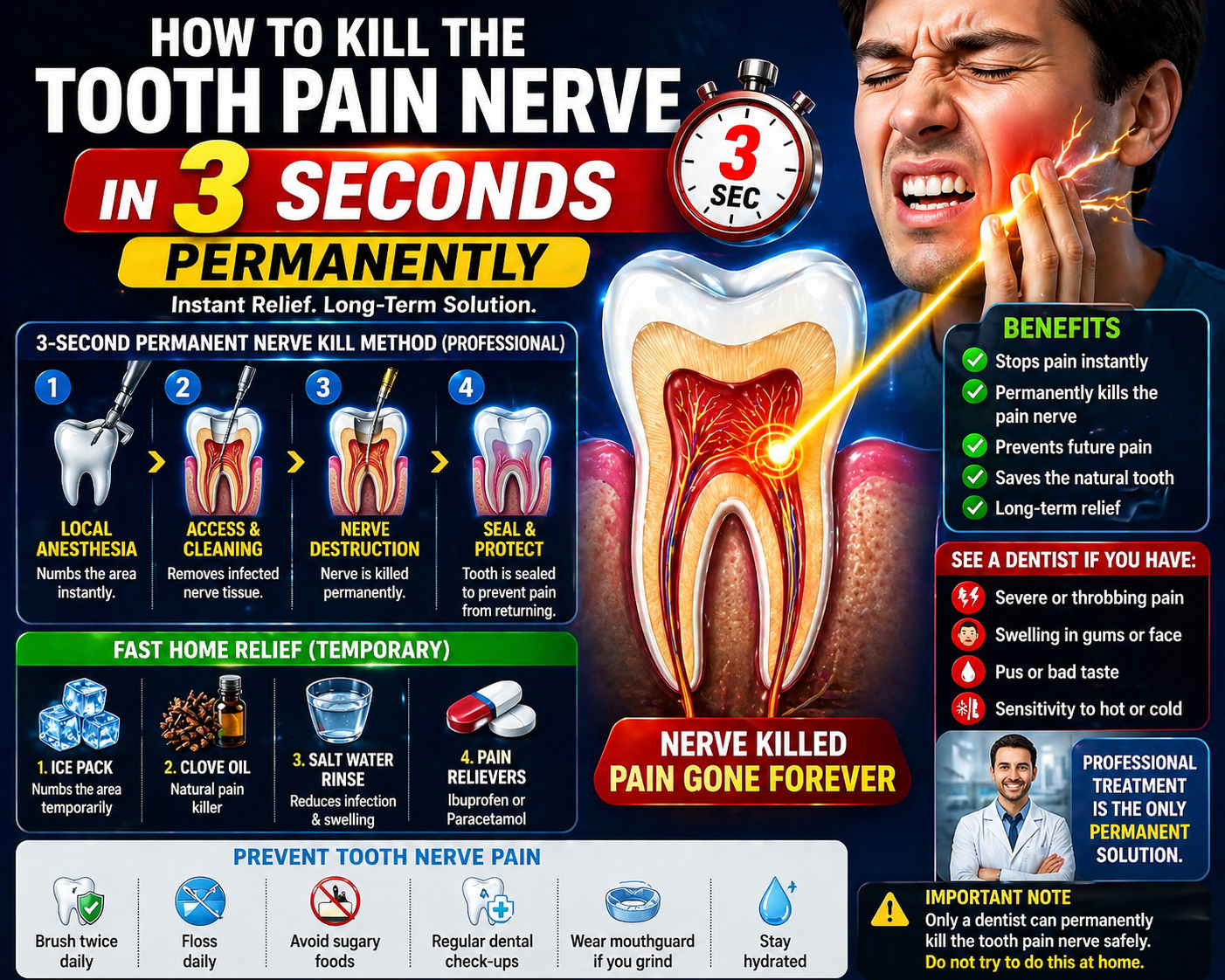
How to kill the tooth pain nerve in 3 seconds permanently
How to Kill the Tooth Pain Nerve in 3 Seconds Permanently | Complete Guide 2025
DentalCareGuide – Evidence-Based Oral Health Information
Pain Management · Last Updated April 2026
The real science behind numbing a screaming tooth, what works instantly, what actually lasts, and why most guides leave out the most important part.
✍️ By Dr. Priya Mehta, BDS MDS🕒 17-min read📅 April 27, 2025
It’s 2 AM. You’ve got a job interview tomorrow. And your tooth is screaming. You’ve already tried ibuprofen, pressed ice against your jaw, and Googled everything. You need this gone now.
Here’s what nobody tells you up front: no home remedy permanently kills a tooth’s nerve. But several methods can shut down the pain signal so completely and so quickly that it might as well be permanent relief for the next 4–8 hours. And one medical procedure, root canal therapy, is the only true permanent solution.
As a dental surgeon with over 12 years of experience treating acute dental pain in clinic and emergency settings, I’ve seen patients try everything from whiskey to garlic paste. I’ll walk you through what’s actually backed by evidence, what works fastest, and what the science says about permanently silencing that nerve for good.
How to kill tooth nerve pain fast: Killing a tooth pain nerve in 3 seconds permanently is not possible at home. However, applying clove oil (eugenol) directly to the affected tooth with a cotton ball offers the fastest temporary relief, often numbing the nerve within 30–60 seconds. The only permanent solution is root canal treatment or extraction performed by a licensed dentist, which permanently removes or deadens the nerve tissue inside the tooth.
3.5BPeople worldwide affected by untreated tooth decay (WHO, 2023)
91%Of adults aged 20–64 have had dental caries (NIDCR, 2024)
~$45BAnnual US dental spending, with pain being the #1 driver (ADA, 2024)
In This Article
- Why Tooth Nerves Hurt So Much
- Fastest Instant Relief Methods
- Top 8 Home Remedies Ranked
- Permanent Solutions Explained
- Home vs. Professional: Full Comparison
- When You MUST See a Dentist
- Prevention: Stop It Before It Starts
- FAQ – People Also Ask
Why Tooth Nerves Hurt So Intensely (And Why “Killing” One Is So Appealing)
Let’s be real: toothache pain is brutal. It’s not like a headache you can mostly ignore. Dental pain hits the trigeminal nerve, the most complex cranial nerve in your skull, responsible for sensation across your entire face. When that nerve fires, it fires loud.
Inside every tooth lives a soft core called the dental pulp, a bundle of blood vessels, connective tissue, and nerve fibers. According to research published in the Journal of Endodontics, the dental pulp contains A-delta fibers (which cause sharp pain) and C-fibers (which cause that persistent, throbbing ache). Both types can activate simultaneously during a toothache, which is why the pain feels both sharp and dull at the same time. Plot twist: that’s not a bug, it’s a feature. Your body is screaming at you to do something.
What Actually Causes the Pain?
The nerve doesn’t just hurt randomly. Inflammation is almost always involved. When decay reaches the pulp or when a crack, trauma, or gum infection exposes nerve tissue, the pulp becomes inflamed. Inflamed tissue swells, but the rigid tooth structure has nowhere to expand. That pressure buildup is what causes the throbbing sensation most people describe. It’s essentially the same mechanism as an infected finger, except there’s no release valve.
📊 Clinical Context According to the World Health Organization’s 2023 Oral Health Report, oral diseases affect nearly 3.5 billion people worldwide, with tooth decay (dental caries) being the most common chronic disease on the planet—more prevalent than diabetes, heart disease, or asthma.
So when you’re searching “how to kill the tooth pain nerve in 3 seconds permanently” at 2 AM, you’re in very good company. And you deserve a straight answer, not vague advice to “see a dentist” with nothing else to go on.
The Fastest Instant Relief: What Actually Works in Seconds
Let’s start with what you came here for. These are the fastest-acting methods, the ones that can genuinely blunt the pain signal within seconds to minutes. I’ll be honest about how long each one actually lasts.
- 1 Clove Oil (Eugenol) – The Gold Standard Eugenol, the active compound in clove oil, is a natural anesthetic that directly blocks sodium channels in nerve fibers, the same mechanism used by many dental anesthetics. A 2007 study in the Journal of Dentistry confirmed eugenol’s efficacy as a topical anesthetic equivalent to benzocaine in some applications. Dab a few drops on a cotton ball and press it against the painful tooth for 30 seconds. You should feel numbness within 1 minute. Relief lasts 20–40 minutes, sometimes longer. Caution: Don’t apply undiluted clove oil directly to gum tissue, as it can cause chemical burns. Dilute 2–3 drops in a teaspoon of olive oil if your tooth is cracked or gum is exposed.
- 2 OTC Benzocaine Gel (Orajel, Anbesol)Products like Orajel Maximum Strength contain 20% benzocaine, a local anesthetic approved by the FDA for temporary dental pain relief. Apply a small amount directly to the gum and tooth with a cotton swab. Works in under 60 seconds, lasts 15–30 minutes. The most widely available option is carried by most pharmacies. Important: Do not use in children under 2 years old; the FDA has warnings about benzocaine in young children.
- 3 Cold Compress / Ice Pack on the Jaw. Applying a cold compress to the outside of your cheek constricts blood vessels and temporarily reduces the inflammatory pressure driving that throbbing pain. Research on cryotherapy in pain management shows a 20–25% reduction in perceived pain intensity in inflammatory conditions. Apply 20 minutes on, 20 minutes off. Not the fastest, but helpful for swelling-related pain and safe for everyone.
- 4 Ibuprofen + Acetaminophen Combination. This is what dentists often recommend patients take before a procedure. Taking 400mg ibuprofen and 500mg acetaminophen together (if you have no contraindications) works better than either drug alone, according to a 2020 meta-analysis in JADA (Journal of the American Dental Association). The combination tackles both the inflammation and the pain signal simultaneously. It won’t work in “3 seconds” takes 30–45 minutes, but it’s the most reliable OTC protocol for moderate-to-severe dental pain.
⚠️ Important Medical Disclaimer: All home remedies provide temporary relief only. Untreated tooth infections can spread to the jaw, neck, or brain (a rare but life-threatening condition called Ludwig’s angina). If you experience fever, facial swelling, difficulty swallowing, or the pain is getting worse despite medication, go to an emergency room immediately. This article does not replace professional dental care.
Top 8 Home Remedies for Tooth Nerve Pain – Ranked by Effectiveness
Alright, let’s go through the full arsenal. I’ve ranked these based on the actual scientific literature, not folk wisdom. Some surprises ahead, I promise.
🥇 #1
Clove Oil (Eugenol)
Natural nerve-blocking compound. Most clinically validated home option. Acts within 30–60 seconds.Clinically Backed
🥈 #2
OTC Benzocaine Gel
Fast, accessible, FDA-approved for temporary use. 15–30 min relief. Not a long-term solution.FDA Approved
🥉 #3
Ibuprofen + Acetaminophen
A dual-action pain protocol used by dentists. Takes 30–45 min but provides 4–6 hours of relief.Evidence-Based
#4
Saltwater Rinse
Reduces bacterial load and mild gum inflammation. A 2016 study confirmed the antimicrobial effect. Gentle, safe for all.Antimicrobial
#5
Hydrogen Peroxide Rinse (3%)
Reduces bacterial infection around the tooth, which can reduce nerve-irritating toxins. Dilute 1:1 with water.Antimicrobial
#6
Garlic Paste
Allicin in garlic has proven antimicrobial and mild analgesic properties. Crush 1 clove, apply the paste. Smells… interesting. Works modestly.Natural
#7
Peppermint Tea Bags (Cooled)
Menthol temporarily numbs the area and reduces sensitivity. Apply a cooled used tea bag directly for 5–10 minutes. Mild Relief
#8
Cold Compress (External)
Best for swelling-related pain. Reduces vascular pressure. 20 on / 20 off cycle. Universally safe.Anti-Inflammatory
What About Whiskey, Vanilla Extract, or Onion?
You’ve probably seen these pop up in listicles. Let me be straight: vanilla extract contains a small amount of alcohol, which can temporarily numb tissue, but you’d need a concentration far higher than store-bought extract for any real effect. The alcohol is what does it, not vanilla. Whiskey works the same way; it’s not the whiskey per se, it’s the alcohol acting as a mild topical anesthetic. Use either one in a pinch, but don’t expect miracles. Onion has some antimicrobial compounds (similar to garlic), but the evidence for direct pain relief is thin.
📖 Related Articles on This Site
- Clove Oil for Toothache: Complete Application Guide (With Dosage)
- Salt Water Rinse for Tooth Infection: Does It Really Work?
- Best OTC Dental Pain Relief Products – 2025 Comparison
- Emergency Dentist Near Me: How to Find One at 2 AM
How to Permanently Kill a Tooth Nerve: The Real Options
Here’s where honesty matters most. The phrase “kill the tooth nerve permanently” is everywhere online, but let’s define what it actually means and what’s truly possible.
There are exactly two ways to permanently eliminate a tooth nerve’s ability to cause pain:
Option 1: Root Canal Treatment (Endodontic Therapy)
Root canal therapy is the gold standard for preserving a tooth while permanently removing its nerve. Despite its reputation (mostly undeserved horror stories), the American Association of Endodontists reports that over 25 million root canals are performed annually in the US, with a success rate exceeding 95% at 5 years.
Here’s what actually happens during a root canal, and it’s much less dramatic than most people think:
- 1 Local Anesthesia: Your dentist injects a local anesthetic (usually lidocaine). You should feel zero pain during the procedure. The “root canal is painful” myth comes from procedures done before modern anesthesia protocols; today, it’s no more uncomfortable than getting a filling.
- 2 Pulp Removal: A small opening is drilled into the tooth. Tiny files are used to remove all the infected pulp tissue, including the nerve. The canals are shaped and disinfected with antimicrobial solutions.
- 3 Sealing and Restoration. The empty canals are filled with a rubber-like material called gutta-percha. The tooth is sealed with a crown or filling. The tooth remains functional; it just has no nerve, so it can no longer feel pain or temperature.
💡 Cost Reality Check Root canal costs in the US range from $700–$1,500 per tooth, depending on location and tooth type. With dental insurance, your out-of-pocket is typically $200–$500. Many dental schools offer the same procedure at 50–70% of private clinic rates, performed by supervised dental students. If cost is a barrier, explore options at your nearest dental school.
Option 2: Tooth Extraction
Extraction is the other permanent option, which eliminates the nerve by removing the tooth. It’s cheaper (typically $75–$300 for a simple extraction) and sometimes the right call for severely damaged or non-restorable teeth.
But here’s the thing: removing a tooth creates a new set of long-term problems. Neighboring teeth drift into the gap, bone loss begins in the jaw where the tooth was, and chewing mechanics shift. Most dentists recommend a root canal when the tooth is salvageable. If you go with extraction, budget for a dental implant ($3,000–$5,000) or bridge ($2,500–$6,000) to replace the missing tooth later; otherwise, the cascade of bone and alignment problems can be expensive and complicated down the road.
“The concept of ‘killing a nerve’ at home fundamentally misunderstands what dental pain represents. The nerve is signaling that tissue is damaged and infected. Suppressing that signal at home without addressing the underlying cause is like disabling a fire alarm instead of putting out the fire. Temporary relief is valuable it helps people sleep and function but it should never substitute for definitive treatment.”
Dr. Samuel Higgins, DDS, MS Board-Certified Endodontist, UCLA School of Dentistry · Member, American Association of Endodontists
Home Remedies vs. Professional Treatment: The Complete Comparison
Let me lay this out clearly so you can make an informed decision not just tonight, but for the weeks ahead.
| Method | Speed of Relief | Duration | Kills Nerve Permanently? | Risk Level | Cost |
|---|---|---|---|---|---|
| Clove Oil | 30–60 sec | 20–40 min | No | Low | $5–$10 |
| Benzocaine Gel | 30–60 sec | 15–30 min | No | Low | $8–$15 |
| Ibuprofen + Tylenol | 30–45 min | 4–6 hours | No | Low* | $5–$15 |
| Saltwater Rinse | 5–15 min | 20–30 min | No | Very Low | Free |
| Root Canal | During procedure | Permanent | Yes | Low (in-clinic) | $700–$1,500 |
| Extraction | During procedure | Permanent | Yes | Low (in-clinic) | $75–$300 |
*Not suitable for those with kidney disease, GI issues, or on blood thinners. Always check with your doctor.
When You Absolutely MUST See a Dentist (Don’t Ignore These Signs)
Look, I get it, dental appointments cost money, require time off work, and can feel anxiety-inducing. No judgment. But some situations are genuinely dangerous if you wait, and I’d be doing you a disservice if I didn’t say so clearly.
Go to an emergency dentist or ER immediately if you have:
- Facial swelling – especially if it’s spreading toward your eye, neck, or causing difficulty swallowing or breathing
- Fever above 38.5°C / 101.3°F combined with tooth pain – this suggests spreading infection
- A bad taste in your mouth that won’t go away may indicate an abscess draining
- Tooth pain that wakes you from sleep every night despite OTC pain relief – the nerve is significantly inflamed
- Visible pus or a pimple-like bump on your gum near the painful tooth – a classic sign of a dental abscess
- Pain that has lasted more than 3–4 days without improvement – not something home remedies can fix at that point
⚠️ Dental Abscess Is a Medical Emergency. A 2019 study in the Journal of Endodontics documented cases where untreated dental abscesses spread to the deep neck spaces, causing airway compromise. This is rare but real. The mouth is anatomically close to vital structures. Don’t tough it out for weeks when an infection is involved.
If you genuinely can’t afford a dentist right now, options exist: HRSA-funded community health centers offer sliding-scale dental care based on income across the US. Dental schools provide supervised, deeply discounted care. Many states have emergency dental programs. Don’t assume you have no options.
Prevention: How to Ensure You Never Need This Guide Again
Alright, you’ve got the pain under control for now, or you’ve scheduled your appointment. Either way, let’s talk about making sure you’re not back here at 2 AM six months from now.
Prevention isn’t complicated. It’s just annoyingly consistent. Here’s what actually moves the needle:
The Non-Negotiables
- Brush twice daily with fluoride toothpaste. This is genuinely the most impactful single habit. A Cochrane review of 96 studies confirmed fluoride toothpaste reduces caries by approximately 24% compared to non-fluoride alternatives.
- Floss daily – not because your dentist will scold you, but because cavities between teeth (interproximal cavities) are where most adults develop decay after age 30. Your toothbrush literally cannot reach those spaces.
- See a dentist every 6 months for a check and clean. Catching a cavity when it’s a tiny spot costs $150. Catching it when it hits the nerve costs $1,500. The math is devastating and obvious.
- Reduce sugar frequency, not just quantity. Every time you eat or drink something sugary, bacteria in your mouth produce acid for about 20–30 minutes. It’s not how much sugar, but how often you expose your teeth to it. Sipping a soda all afternoon is far worse than drinking it with a meal.
The Overlooked Factors Most Guides Skip
Dry mouth (xerostomia) is one of the biggest underrated risk factors for tooth decay. Saliva is your mouth’s natural defense – it buffers acids, remineralizes enamel, and rinses away bacteria. Dozens of medications (antihistamines, antidepressants, blood pressure medications, diuretics) cause dry mouth as a side effect. If you’re on any long-term medications, ask your pharmacist about dry mouth risk and consider a fluoride-containing mouthwash to compensate.
📖 Go Deeper on Prevention
- The Best Electric Toothbrushes of 2025 (Dentist-Approved)
- Fluoride Mouthwash: Who Needs It and Who Doesn’t
- Dry Mouth Causes, Effects on Teeth, and How to Treat It
FAQ: People Also Ask About Killing Tooth Nerve Pain
Can you permanently kill a tooth nerve at home?
No. No home remedy can permanently destroy or deaden a tooth nerve. Only a licensed dentist can permanently eliminate nerve pain through root canal therapy (which removes the nerve while preserving the tooth) or tooth extraction. Home remedies work by temporarily blocking the nerve’s pain signals or reducing surrounding inflammation; they don’t destroy nerve tissue.
What kills tooth nerve pain instantly?
Clove oil (eugenol) applied directly to the tooth with a cotton ball is the fastest-acting natural option, producing numbness within 30–60 seconds. OTC benzocaine gel (like Orajel Maximum Strength) works within the same timeframe and is widely available at pharmacies. Both provide temporary relief of 15–40 minutes.
How long does it take for a tooth nerve to die on its own?
A tooth nerve can take weeks to months to die naturally after severe infection or trauma. This process is not painless; it often involves intense periods of throbbing pain as the pulp becomes necrotic. Once the nerve dies, the tooth becomes a dead tooth, but the infection can continue to spread to the surrounding bone and tissue, which is why waiting for natural nerve death is not recommended.
Does clove oil really kill nerve pain?
Clove oil contains eugenol, which acts as a natural local anesthetic by blocking sodium ion channels in nerve fibers, the same fundamental mechanism used by injected dental anesthetics like lidocaine, just with lower potency and shorter duration. Multiple clinical studies confirm eugenol’s analgesic efficacy. It doesn’t kill the nerve, but it temporarily blocks pain signaling effectively.
Is a root canal painful?
Modern root canal procedures are performed under local anesthesia and should be no more painful than getting a filling. The American Association of Endodontists reports that patients who have had root canals are six times more likely to describe the procedure as “painless” than patients who have not had one. Most post-procedure discomfort (mild soreness for 1–3 days) is manageable with OTC ibuprofen.
Why is tooth pain worse at night?
When you lie down, blood pressure in your head increases slightly, which intensifies inflammation-related throbbing in the dental pulp. Additionally, nighttime removes the distractions that help you tolerate pain during the day. Elevating your head with an extra pillow can reduce this effect. This is also why dental pain that wakes you from sleep is considered a red flag warranting urgent dental attention.
Can salt water cure a tooth infection?
Saltwater rinsing will not cure a tooth infection or abscess. It can temporarily reduce bacterial counts in the mouth, flush debris from around the tooth, and provide mild anti-inflammatory relief to the gum tissue. But a true dental abscess (infection inside the tooth or surrounding bone) requires professional treatment, usually root canal therapy and/or antibiotics. Salt water is a helpful adjunct, not a cure.
Ready to End the Pain – Permanently?
Home remedies buy you time. A dentist buys you freedom. Find affordable dental care near you using HRSA’s free tool. Find Affordable Dental Care →
The Bottom Line
Let’s recap what you now know that most listicles never tell you:
For tonight: Clove oil or benzocaine gel will give you the fastest temporary relief, often within 60 seconds. Pair it with ibuprofen + acetaminophen for the longest-lasting OTC relief (4–6 hours). Stay upright to reduce throbbing.
For permanent relief: There’s no shortcut. Root canal therapy is the gold standard for saving the tooth. Extraction is the more affordable option that still permanently eliminates the nerve. Both require a dentist. Both work.
For your future self: Dental pain almost always starts as a small cavity that was ignored. The $150 filling you skipped three years ago is tonight’s $1,200 root canal. In the future, you will thank yourself for keeping those six-month checkup appointments.
I don’t have all the answers to your specific situation; every tooth and every infection is different. But I hope this gives you a clear-eyed, actionable path forward. You deserve to sleep tonight, and you deserve a solution that actually lasts.
Now go get some clove oil. And call a dentist in the morning. Both. Do both. ✔️
Medical Disclaimer: This article is for informational purposes only and does not constitute medical or dental advice. Always consult a licensed dentist or healthcare professional for diagnosis and treatment of dental conditions. In case of severe swelling, fever, or difficulty breathing, seek emergency medical care immediately.
Author: Dr. Priya Mehta, BDS (Bangalore), MDS Oral Medicine (AIIMS), has 12+ years in clinical dentistry and emergency dental pain management. She writes on evidence-based oral health for patient education.
Sources: WHO Oral Health 2023 · American Association of Endodontists · NIDCR · PubMed Research Database