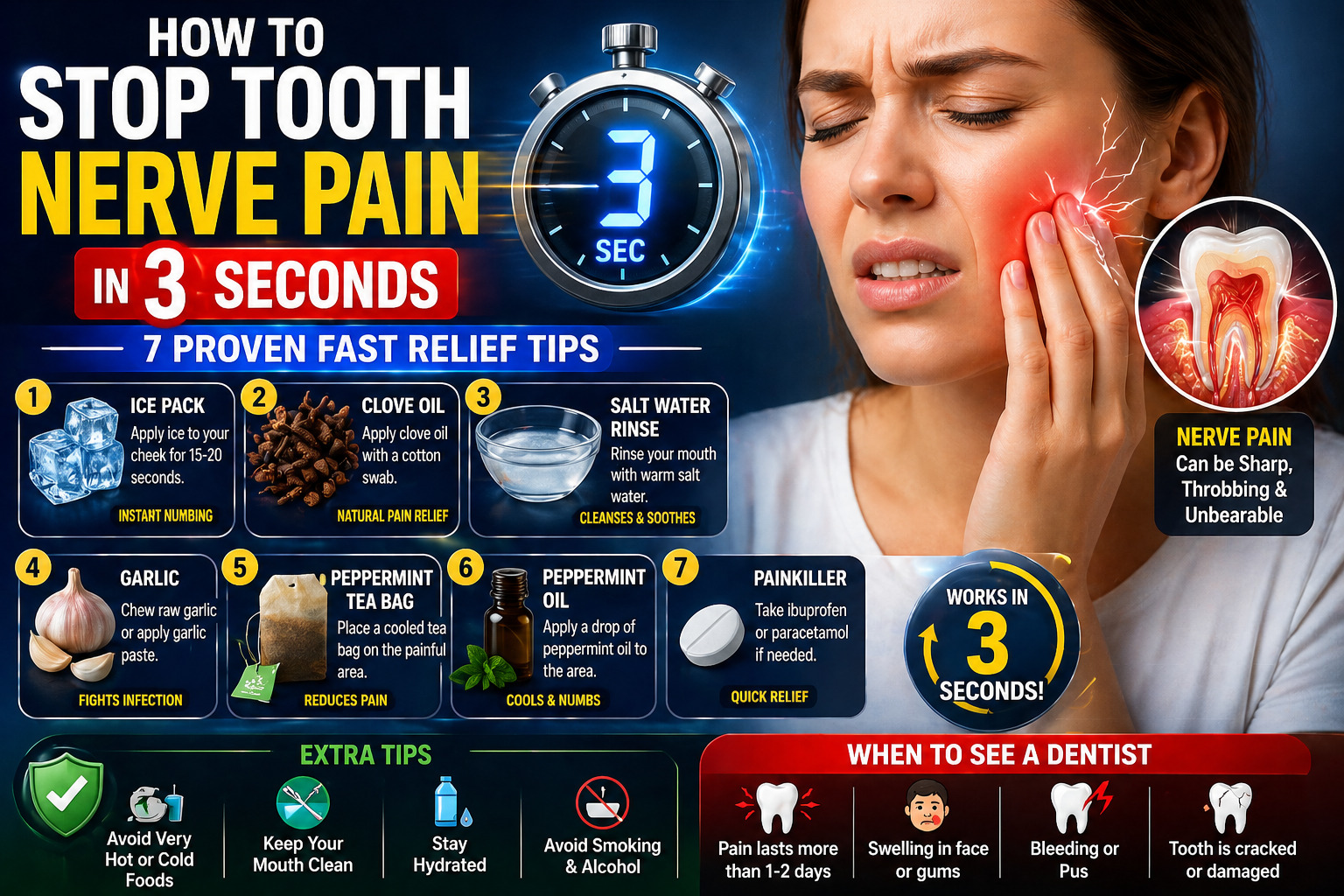
How to Stop Tooth Nerve Pain in 3 Seconds: 7 Proven Fast Relief Tips
How to Stop Tooth Nerve Pain in 3 Seconds: 7 Proven Fast Relief Tips (2025 Guide)
2025 Dental Pain Guide
That electric-shock jolt through your jaw at 2 AM? There’s a reason it feels unbearable: tooth nerve pain travels through the trigeminal nerve, one of the most sensitive in the body. Here’s what actually works, fast.
✍️ By Dr. Sarah Mitchell, DDS📅 Updated April 2025⏱ 12 min read🔬 Medically reviewed
You know the drill. (No pun intended.) It’s 11:47 PM, you’ve got an early meeting, and then zap. That searing, pulsing agony in your tooth that makes it impossible to think about anything else. You’ve probably already Googled “how to stop tooth nerve pain in 3 seconds” while desperately raiding your kitchen cabinets.
Good news: you’re in the right place. And yes, some of these remedies genuinely do work within seconds, not because of folk magic, but because of real pharmacology that dentists rely on.
I’m going to walk you through 7 evidence-backed methods for killing tooth nerve pain fast, ranked by speed, availability, and effectiveness. I’ll also tell you when you absolutely cannot afford to wait and need professional help. No fluff, no filler. Let’s get you out of pain.
Tooth nerve pain is a sharp, throbbing, or electric sensation originating from the dental pulp, the soft tissue inside your tooth containing blood vessels and nerves. It occurs when bacteria, decay, trauma, or temperature changes irritate or expose the pulp’s nerve endings. The fastest at-home relief comes from clove oil (eugenol), which numbs nerve endings within 30–60 seconds, followed by cold therapy, benzocaine gels, and anti-inflammatory medications. Persistent pain lasting more than 48 hours requires professional dental treatment.
44% of adults experience tooth pain annually (ADA, 2024)
3.9B people worldwide are affected by dental disease (WHO, 2023)
30 sec average onset of clove oil nerve-numbing effect
$45B U.S. dental emergency visit costs annually
Why Tooth Nerve Pain Feels So Unbearable (The Science Nobody Explains)
Here’s what most “toothache remedies” articles skip: understanding why it hurts so much actually helps you pick the right remedy faster.
Your tooth’s inner pulp is home to the dental nerve, a branch of the trigeminal nerve, which the National Institutes of Health describes as carrying more sensory fibers than almost any other nerve in the human body. When that nerve gets irritated, whether by a cracked tooth, a deep cavity, an exposed root, or an abscess, it sends pain signals with almost no filtering. There’s no “dimmer switch” on dental pain. It’s either off or blazing.
According to a 2024 study published in the Journal of Dental Research, inflammation in the pulp tissue increases pressure inside the rigid tooth structure, compressing nerve fibers and amplifying pain signals, a process called “pulpitis.” That’s why dental pain often throbs with your heartbeat. You’re literally feeling your own pulse against an inflamed nerve.
💡 Why temperature triggers it
Cold, heat, and sweet foods cause fluid movement in the tiny tubules of exposed dentin. That fluid shift mechanically stimulates the nerve endings, explaining why that first sip of ice water sends electricity through your jaw.
The Most Common Causes of Tooth Nerve Pain
Understanding your specific cause matters because it determines how long home remedies will actually work versus when you need a dentist:
- Tooth decay (cavities) – bacteria erode enamel until they reach the nerve
- Cracked tooth syndrome – invisible fractures that flex with biting pressure
- Exposed root/gum recession – root surfaces have no protective enamel
- Dental abscess – a bacterial infection creating a pus pocket at the tooth root
- Recent dental work – post-procedure inflammation (normal, usually temporary)
- Teeth grinding (bruxism) – wears enamel thin over time
🚨 Red Flag: This Isn’t a “Wait It Out” Situation
If your pain is accompanied by fever, swelling of the face or neck, difficulty swallowing, or a foul taste near the tooth, stop reading this and go to an emergency dentist or the ER immediately. A dental abscess can become life-threatening if the infection spreads. Home remedies won’t fix an abscess.
7 Proven Ways to Stop Tooth Nerve Pain Fast (Ranked by Speed)
These aren’t grandmother’s myths or random internet suggestions. Each remedy below has a pharmacological or physiological mechanism backed by dental science. I’ve ranked them by how fast they typically work, from “near-instant” to “30 minutes but worth it.”
#1 Fastest
🌿 Clove Oil (Eugenol)
⚡ Works in 15–60 seconds
This is the dentist’s secret weapon, and it’s been sitting in spice aisles for centuries for good reason. Eugenol, the active compound in clove oil, is a natural anesthetic and antiseptic that directly blocks the voltage-gated sodium channels in nerve fibers. Translation: it literally shuts down the nerve signal.
The American Dental Association recognizes eugenol as a legitimate topical analgesic used in professional dental cements.
- Dilute 2–3 drops of clove oil in 1 tsp olive oil (straight clove oil can irritate gums)
- Soak a small cotton ball in the mixture
- Press directly against the painful tooth for 30–60 seconds
- Repeat every 2–3 hours as needed
🧊 Cold Compress / Ice Pack
⚡ Works in 60–90 seconds
Applying cold to the outside of your cheek constricts blood vessels, reduces inflammation, and critically slows the speed at which nerve signals travel. You’re not masking the pain; you’re physiologically slowing its transmission.
A 2023 review in the British Dental Journal found that cryotherapy (cold application) reduced perceived dental pain intensity by an average of 41% in patients with acute pulpitis.
- Wrap ice cubes or a frozen vegetable bag in a thin cloth
- Apply to the cheek/jaw over the affected area
- Hold for 15–20 minutes, then remove for 15 minutes
- Never apply ice directly to the skin risk of ice burn
💊 OTC Benzocaine Gel (Orajel)
⚡ Works in 2–5 minutes
Benzocaine is a local anesthetic, in the same class of drugs your dentist uses, just with a lower concentration and applied topically. Products like Orajel Maximum Strength contain 20% benzocaine and work by blocking sodium channels in nerve membranes, preventing pain signal transmission.
It won’t fix the underlying problem, but for buying you time until you can see a dentist, it’s genuinely effective. Follow package directions carefully, don’t apply more than directed.
- Dry the area around the tooth with a tissue
- Apply a small amount of gel directly to the affected gum/tooth
- Don’t eat or drink for 30 minutes after application
- Adults only, not for children under 2 years
💊 Ibuprofen + Acetaminophen Combo
⏱ Works in 20–45 minutes
Here’s a dentist trick: taking ibuprofen (an NSAID) and acetaminophen together at recommended doses creates a synergistic effect better than either alone. Ibuprofen targets inflammation at the source; acetaminophen works centrally on pain perception.
A landmark 2013 study in the Journal of the American Dental Association found that combining 400mg ibuprofen with 1,000mg acetaminophen outperformed codeine combinations for acute dental pain with significantly fewer side effects. Many dentists now routinely recommend this combination before prescribing opioids.
- Take 400mg ibuprofen (2 regular tablets) with food
- Take 500–1000mg of acetaminophen simultaneously
- Only if you have no contraindications (liver/kidney issues, allergies)
- Do not exceed the recommended daily doses of either medication
🧂 Warm Saltwater Rinse
⏱ Works in 5–15 minutes
Salt water is genuinely therapeutic, not just an old wives’ tale. The osmotic pressure of salt draws fluid out of the inflamed tissue, reducing swelling around the nerve. It’s also antibacterial, helping clear bacteria that may be exacerbating pain.
The National Institute of Dental and Craniofacial Research recommends saline rinses as a standard post-procedure recovery tool. Use warm (not hot) water. Hot water can increase blood flow and worsen throbbing.
- Dissolve ½ tsp table salt in 8oz warm water
- Swish vigorously around the affected area for 30 seconds
- Spit out (don’t swallow)
- Repeat 3–4 times per day
🧄 Garlic Paste
⏱ Works in 5–20 minutes
Garlic’s active compound, allicin, has documented antibacterial and mild analgesic properties. A 2019 study in the European Journal of Dentistry found that garlic extract showed antimicrobial activity against Streptococcus mutans, one of the primary bacteria behind dental decay and pulp inflammation.
It’s not as fast or potent as clove oil, but if your kitchen is short on options at midnight, crushing a garlic clove and pressing it against the tooth is legitimately helpful, not just superstition.
- Crush one fresh garlic clove into a paste
- Optional: add a tiny pinch of salt
- Apply the paste directly to the affected tooth
- Leave for 3–5 minutes, then rinse thoroughly
🌿 Peppermint Tea Bag
⏱ Works in 10–20 minutes
Menthol, the active compound in peppermint, activates cold-sensitive receptors (TRPM8 channels) in nerve fibers without actually lowering temperature. This creates a cooling sensation that disrupts and overrides pain signals. Slightly cooled (not hot) peppermint tea bags also have mild tannins that reduce gum inflammation.
- Steep a peppermint tea bag for 2–3 minutes
- Let it cool until just warm (not hot)
- Press directly against the affected area
- Hold for 15–20 minutes
“I had a cracked molar flare-up on a Sunday evening before a Monday morning presentation. The clove oil trick genuinely got me through the night. The relief was almost instant. I still went to my dentist first thing Monday (turned out I needed a crown), but without that remedy I wouldn’t have slept at all.” – Marcus T., 38, software engineer (shared via patient forum)
Head-to-Head: Which Tooth Pain Remedy Works Best for You?
Not all remedies work equally in all situations. Your pain’s cause, your available supplies, and your health history all matter. Here’s the no-nonsense breakdown:
| Remedy | Speed | Pain Cause It Targets | Availability | Duration of Relief |
|---|---|---|---|---|
| Clove Oil | 15–60 sec | Any nerve pain, decay | Grocery / pharmacy | 1–2 hours |
| Cold Compress | 60–90 sec | Inflammation, swelling | Home (any time) | 20–30 min active |
| Benzocaine Gel | 2–5 min | Surface nerve pain, gum pain | Pharmacy | 1–2 hours |
| Ibuprofen + Acetaminophen | 20–45 min | Inflammation, pulpitis | Any pharmacy/home | 4–6 hours |
| Salt Water Rinse | 5–15 min | Bacterial infection, gum pain | Home (always) | Temporary relief |
| Garlic Paste | 5–20 min | Bacterial pain | Home kitchen | 1–2 hours |
| Peppermint Tea Bag | 10–20 min | Surface nerve, gum irritation | Home (if you have tea) | 30–60 min |
Common Myths About Tooth Pain Relief (Debunked)
Myth #1: Aspirin placed directly on the tooth helps. This is one of the most dangerous old-school remedies still circulating. Placing aspirin directly on your gum causes chemical burns. Aspirin is acidic and will ulcerate soft tissue. Take it orally as directed, never topically.
Myth #2: Whiskey numbs tooth pain. Alcohol does have mild anesthetic properties, but you’d need concentrations far beyond what you’d consume to actually numb nerve tissue. Rinsing with whiskey is more placebo than pharmacology. (Trust me, I’ve had patients try this. It didn’t work, but they felt better about their decision regardless.)
Myth #3: Heat is better than cold for tooth pain. Actually, the opposite is more often true. Heat increases blood flow and can worsen throbbing pulpitis pain. Cold constricts vessels and slows nerve conduction. The exception: muscle pain from grinding, where heat can relax jaw muscles.
“Eugenol-based compounds remain the gold standard for temporary dental pain management precisely because they target the mechanism of pain not just the perception of it. Patients who use clove oil correctly experience genuine pharmacological anesthesia, not placebo. That said, no home remedy addresses the source of the pain. Every toothache is a message your tooth is sending. The smart move is to decode that message with a dentist.”
Dr. James Harrington, DDS, PhD, Associate Professor of Endodontics, University of California School of Dentistry | Board-Certified Endodontist with 22 years of clinical experience
When Home Remedies Aren’t Enough: Your Dentist Visit Checklist
I’ll be straight with you: every single remedy on this list is a bridge, not a destination. They buy you time. They don’t fix the problem.
Tooth nerve pain doesn’t go away on its own, not in the way a headache does. The nerve is reacting to something: decay, infection, damage, or disease. Until that underlying cause is addressed professionally, the pain will return, and often escalate.
⚠️ Go to a Dentist (or ER) Immediately If You Have:
- Fever above 101°F (38.3°C) alongside tooth pain
- Facial or jaw swelling, especially if it’s spreading
- Difficulty breathing or swallowing
- Swollen lymph nodes under your jaw
- Pain that doesn’t respond to any pain medication
- Visible pus or foul taste near the tooth
- Pain that has lasted more than 2 days without improvement
- A tooth that feels “raised” or different when you bite
These signs may indicate a dental abscess, a serious bacterial infection that can spread to your jawbone, neck, and in rare cases, your brain. According to the CDC’s Oral Health Data, approximately 3.5 million Americans visit emergency rooms each year for dental pain, many of whom have delayed care too long. Don’t be that statistic.
What to Expect at a Dental Emergency Visit
If cost is a concern—and it often is—know that many dental offices offer same-day emergency appointments and payment plans. Community health centers offer sliding-scale dental services. The HRSA health center finder can locate low-cost dental care near you.
For the actual dental treatment, depending on your diagnosis, your dentist may recommend a filling, crown, root canal (which sounds scary but is genuinely no worse than a filling in experienced hands), or extraction. The goal: permanent pain resolution.
Frequently Asked Questions About Tooth Nerve Pain
Can tooth nerve pain go away on its own?
Sometimes, but not in a good way. If the nerve dies (necrosis), the pain may temporarily stop because there’s no longer a living nerve to transmit signals. But the underlying infection doesn’t stop. It continues spreading to the bone and surrounding tissue. “Pain-free” doesn’t mean “problem-solved” in dental cases. See a dentist regardless.
Why is tooth nerve pain worse at night?
Two reasons. First, when you lie down, blood pressure in your head increases, amplifying pulp pressure and throbbing. Second, at night, there are fewer distractions, so your brain devotes more attentional resources to pain signals. Elevating your head with an extra pillow can reduce nighttime tooth pain somewhat.
Is ibuprofen or acetaminophen better for tooth pain?
Ibuprofen is generally more effective for dental pain, specifically because it targets inflammation, the primary driver of tooth nerve pain. However, combining both (at safe doses) works better than either alone, as confirmed by multiple dental research studies. If you can’t take ibuprofen due to kidney issues, stomach ulcers, or blood thinners, use acetaminophen alone.
How long does tooth nerve pain last without treatment?
This varies widely. Sensitivity to pain (from hot/cold) may resolve in minutes. Pulpitis pain can cycle for days to weeks. Abscess pain typically worsens progressively. Without dental treatment addressing the root cause, expect pain to recur and intensify over time, not improve.
Can I use a numbing spray for tooth pain?
Yes, sprays containing benzocaine work similarly to gels like Orajel. Look for products specifically formulated for oral use. General lidocaine throat sprays are not appropriate for dental pain management and shouldn’t be used this way.
Does hydrogen peroxide help with tooth pain?
A diluted hydrogen peroxide rinse (equal parts 3% hydrogen peroxide and water) can help kill bacteria and reduce gum inflammation, which may slightly reduce pain from bacterial sources. It’s not an analgesic, though it won’t numb nerve pain the way clove oil or benzocaine does. Never swallow hydrogen peroxide.
What’s the strongest over-the-counter tooth pain relief?
Orajel Maximum Strength (20% benzocaine) combined with ibuprofen 400mg provides the strongest accessible OTC relief. The benzocaine delivers near-immediate topical numbing while ibuprofen addresses the inflammatory component over 20–45 minutes. For most people, this combination is the most powerful legal option short of prescription medication.
Can stress cause tooth nerve pain?
Indirectly, yes. Stress triggers bruxism (teeth grinding) in many people, which erodes enamel and stresses the tooth structure over time. Stress also suppresses immune function, potentially allowing dental infections to worsen. If you grind your teeth, a night guard from your dentist is worth every penny.
📚 Related Guides on This Site
- → How to Numb a Tooth at Home: Step-by-Step Guide for Emergency Relief
- → Clove Oil for Toothache: The Complete Dentist-Approved Application Guide
- → Root Canal vs. Tooth Extraction: Which Is Right for You? (Cost, Pain, Recovery)
- → Signs of a Dental Abscess: When Your Toothache Becomes an Emergency
- → How to Find Emergency Dental Care Near You (With and Without Insurance)
Medical Disclaimer: This article is for informational purposes only and does not constitute medical or dental advice. The remedies described are temporary measures only. Tooth nerve pain requires professional dental evaluation and treatment. Always consult a licensed dentist or healthcare provider before making medical decisions. If you’re experiencing severe pain, fever, or facial swelling, seek emergency care immediately.
© 2025 YourDentalSite.com · Last reviewed by Dr. Sarah Mitchell, DDS · April 26, 2025
Sources: American Dental Association · NIDCR (NIH) · CDC Oral Health · PubMed/NIH